


- About Us
About the University
Jaipur National University, Jaipur is one of the top self-financed private university in Rajasthan sponsored by the Mahima Shiksha Samiti.

Innovation and Incubation
If you have an innovative idea, we can show you the way ahead. Be an entrepreneur with the perfect..
Social Impact/CSR
Social responsibility takes many forms - from providing affordable/free healthcare...
Why JNU?
Their focus is to develop both education and critical skills to help our students excel in life.
- Admissions
- Academics
Schools
- School of Engineering & Technology
- School of Business & Management
- School of Computer & Systems Sciences
- School of Education
- School of Languages, Literature and Society
- School of Life & Basic Sciences
- School of Pharmaceutical Sciences
- School of Media Studies
- School of Fashion Design
- Seedling School of Law and Governance
- Seedling School of Nursing
- Seedling School of Allied and Healthcare Sciences
- School of Agricultural Sciences
- School of Hotel Management & Catering Technology
- Jaipur National University Institute for Medical Sciences and Research Centre
- Research
- Campus Life
Enriching the Intellect

Inspire Your Essence

Outside the classroom

Adapt to Physical Wellness

-

 Admission HelpDesk


-
Duration
4 Years
-
Eligibility
Min. 50% Aggregate in 10+2 with PCM/PCB
-
Selection Procedure
Entrance Test + PI
Program Outcomes
Fundamental Knowledge of Food Technology
The program will equip students with a strong foundation in food processing, preservation, food chemistry, microbiology, and engineering, ensuring they understand the core principles of food technology.
Quality and Safety Evaluation
Students will learn to analyze and evaluate the quality, safety, and nutritional value of food materials using scientific methods and modern analytical techniques, ensuring compliance with food safety standards.
Problem-Solving in Food Production
Graduates will develop the ability to identify, analyze, and solve complex problems in food production, including issues related to spoilage, contamination, and process optimization, by applying critical thinking and technical expertise.
Design and Development of Food Systems
Students will gain skills in designing, developing, and optimizing food processing systems, preservation techniques, and packaging methods, ensuring that these systems meet regulatory, quality, and sustainability standards.
Research and Innovation
The program prepares students to engage in food science research, conducting experiments and data analysis to drive innovation in food technology, including product development and process improvement.
Career Readiness and Industry Preparation
Graduates will be equipped with the knowledge and skills required for entry into the food technology sector, both in the private and public industries, as well as for pursuing advanced studies in food science and technology.
Global and Ethical Perspective
Students will develop an understanding of the ethical, environmental, and societal implications of food production and technology, promoting sustainability, food security, and responsible innovation in the global food industry.
Communication and Teamwork
The program emphasizes effective communication and teamwork, preparing graduates to collaborate with diverse professionals and stakeholders, including researchers, policymakers, and industry leaders, to solve complex food-related challenges. This structure summarizes the key objectives of the B.Tech. Food Technology program, emphasizing the core knowledge areas and skills students will develop.
Career Paths
What would the student become post completing this education?

Production Engineer

Processing In Charge

Quality Assurance and Control

Research and Development Officer

Food Safety Officer

Food Auditor

Packaging Expert

Printing Manager

Hygiene Manager

Academician and Researcher

Food Inspector

Entrepreneur
Curriculum
| Course Category | Paper Title | Credits |
|---|---|---|
| Core | Engineering Graphics and Visualization | 3 |
| Core | Engineering Chemistry | 3 |
| Core | Engineering Mathematics I | 4 |
| Core | Engineering Graphics and Visualization Lab | 1 |
| Core | Engineering Chemistry Lab | 1 |
| Discipline Specific Elective | Fundamental of Electrical and Electronics | 2 |
| Fundamental of Electrical and Electronics Lab | 1 | |
| Introduction to Computer Science | 2 | |
| Introduction to Computer Application Lab | 1 | |
| Ability Enhancement Courses | English | 3 |
| Ability Enhancement Courses | Language Lab | 1 |
| Audit Courses | Sports/Yoga/NSS/NCC | 1 |
| Total | 23 |
| Course Category | Paper Title | Credits |
|---|---|---|
| Core | Programming for Problem Solving using C | 3 |
| Core | Engineering Physics | 3 |
| Core | Engineering Mathematics II | 4 |
| Core | Programming for Problem Solving Lab | 2 |
| Core | Engineering Physics Lab | 1 |
| Skill Enhancement Courses | Design Thinking | 1 |
| Skill Enhancement Courses | Design Thinking & Idea Lab | 1 |
| Discipline Specific Elective | Engineering Mechanics | 3 |
| Smart and Sustainable Energy | ||
| Ability Enhancement Courses | Communication and Soft Skills Lab | 2 |
| Audit Courses | Environmental Science | 2 |
| Total | 25 |
| Course Category | Course Name | Credits |
|---|---|---|
| Core | Basic and Food Microbiology | 3 |
| Core | Food Chemistry | 3 |
| Core | Fluid Mechanics | 3 |
| Core | Food Additives and Contaminants | 3 |
| Core | Basic and Food Microbiology Lab | 1 |
| Core | Food Chemistry Lab | 1 |
| Core | Fluid Mechanics Lab | 1 |
| Core | Heat Transfer Operations Lab | 1 |
| Discipline Specific Elective (Any One) | Basic Food Science | 3 |
| Heat Transfer Operations | ||
| Open Elective | Open Elective | 2 |
| Extra Curricular Activity | Mandatory Qualifying Non-credited but graded Course | |
| Total | 21 |
| Course Category | Course Name | Credits |
|---|---|---|
| Core | Biochemistry & Nutrition | 3 |
| Core | Principles of Food Processing & Preservation | 3 |
| Core | Food Safety and Food Laws | 3 |
| Core | Fermentation Technology | 3 |
| Core | Biochemistry & Nutrition Lab | 1 |
| Core | Principles of Food Processing & Preservation Lab | 1 |
| Core | Group Discussion & Seminar | 1 |
| Core | Minor Project I | 1 |
| Discipline Specific Elective (Any One) | Food Hygiene, Sanitation & Plant Utilities | 3 |
| Process Calculation | ||
| Open Elective | Open Elective | 2 |
| Co Curricular Activity | Mandatory Qualifying Non-credited but graded Course | |
| Total | 21 |
| Course Category | Course Name | Credits |
|---|---|---|
| Core | Cereals & Legumes Processing Technology | 3 |
| Core | Milk & Milk Products Technology | 3 |
| Core | Entrepreneurship & Agribusiness Management | 3 |
| Core | Egg, Poultry, Meat & Fish Processing Technology | 3 |
| Core | Cereals & Legumes Processing Technology Lab | 1 |
| Core | Milk & Milk Products Technology Lab | 1 |
| Core | Minor Project II | 1 |
| Core | Industrial Training and Seminar | 1 |
| Discipline Specific Elective (Any One) | Food Process Engineering | 3 |
| Unit Operations in Food Engineering | ||
| Skill Enhancement Courses (Any One Combination) | Processing and Technology of Spices | 2 |
| Processing and Technology of Spices Lab | 2 | |
| Or | ||
| Nutrition and Wellbeing | 2 | |
| Nutrition and Wellbeing Lab | 2 | |
| Generic Elective (Any One) | Basic Thermodynamics | 3 |
| Organizational Behavior | ||
| Food Biotechnology | ||
| Total | 26 | |
| Course Category | Course Name | Credits |
|---|---|---|
| Core | Fruits and Vegetables Processing Technology | 3 |
| Core | Oils and Fats Processing Technology | 3 |
| Core | Bakery and Confectionary Technology | 3 |
| Core | Food Analysis and Quality Control | 3 |
| Core | Fruits and Vegetables Processing Technology Lab | 1 |
| Core | Oils and Fats Processing Technology Lab | 1 |
| Core | Bakery and Confectionary Technology Lab | 1 |
| Core | Food Analysis and Quality Control Lab | 1 |
| Discipline Specific Elective (Any One) | Advance Techniques in Food | 3 |
| Food Storage and Transport Engineering | ||
| Skill Enhancement Courses (Any One Combination) | Good Laboratory Practice & Good Manufacturing Practices | 2 |
| Good Laboratory Practice & Good Manufacturing Practices Lab | ||
| OR | ||
| Indian Sweets and Snacks Technology | 2 | |
| Indian Sweets and Snacks Technology Lab | 2 | |
| Generic Elective (Any One) | Chemical Reaction Engineering | 3 |
| Supply Chain Management | ||
| Biotechnological Tools in Food | ||
| Total | 26 |
| Course Category | Course Name | Credits |
|---|---|---|
| Core | Food Packaging | 3 |
| Core | Plant Design and Project Engineering | 3 |
| Core | Food Industry Waste Management & By Product Utilization | 3 |
| Core | Food Product Development, Marketing and Sales | 3 |
| Core | Food Packaging Lab | 1 |
| Core | Plant Design and Project Engineering Lab | 1 |
| Core | Food Industry Waste Management & By-Product Utilization Lab | 1 |
| Core | Industrial Training and Seminar | 1 |
| Discipline Specific Elective (Any One) | Nutraceuticals, Functional and Therapeutic Foods | 3 |
| Flavor Technology | ||
| Generic Elective (Any One) | Mass Transfer Operations | 3 |
| Digital Marketing | ||
| Industrial Biotechnology | ||
| Total | 22 |
| Course Category | Course Name | Credits |
|---|---|---|
| Core | Industrial Internship/Project Work | 16 |
Tuition Fee
₹1,22,200
Note
*Lab & Library fee will be charged separately
#Program Proposed from Session 2026-27

Apply for admissions at Jaipur National University
APPLY ONLINE 1800-102-1900
  admissions@jnujaipur.ac.in
 Internship Opportunities








Engage, Connect and Experience
the vibrant Life at JNU
Acres Green
Campus
State-of-the-Art
Labs
Smart
Classrooms
Signature Annual
Events
Student
Clubs

Enriching the
Intellect


Inspire Your
Essence






Frequently Asked Questions
This course helps students in all ways such as developing technical skills, soft skills, and analytical skills. It is a science which deals with the techniques and principles involved in processing and preserving the food substances. The application of food science helps in manufacturing safe, wholesome and nutritious food products. Developments in food technology have contributed greatly to the food supply and have changed our world.
The technology sector is booming and the demand for Bachelor of Technology [B.Tech] graduates are more than ever. This course is a multidisciplinary course which involves the study of Food Science, Quality, Safety, Packaging, Processing and Preservation of Food products.
It is the fastest growing branch of Engineering and Technology because there is a huge demand of packaged foods in India and abroad and hence new Food Industries are starting up year by year and therefore there is an increasing demand of Food Technology specialist in India and abroad. So it's a good decision to pursue B.Tech in Food Technology after 12 th standard.
Yes, as the degree offered in B.Tech. in Food Technology . A professional in the field of Food Technology can find the employment in the field of Food manufacturing plant, research and development labs etc. People can choose the area of their working as per the interest of their subject.
There are plenty of job opportunities for food technologists in the country and abroad. Food Technology graduates can work in:
- Production and Processing: Look after the designing of plants and equipment handling in processing of food.
- Quality Assurance and Control: Ensures the quality from raw stage to finished product
- Research and Development: Conduct research on new to the world product
- Food Safety Auditing: Devoted to the chemical testing of food products
- Entrepreneurship: Self employment
- Govt. Projects and Jobs (FCI, Ag Mark, FSSAI, MoFPI, BIS, Banks etc.)
- Packaging and Printing
- Hygiene and Sanitation
- Consultancy (Plant Designing, Engineering, Safety, Quality, Certification etc.)
- Food Inspectors, Food Safety Officers: Make sure that the food products are as per the certified standards.
- Sensory Scientist: Identification of attributes that matter most to the end consumer relating to senses of sight, smell, taste & touch.
- Food Microbiologist: Makes sure that the food is fit for consumption and is free from microbial contamination.
- Nutrition and Dietician: Ensures that the food is nutritionally wholesome and in accordance to the RDA's.
- Academics and Research
During the four year course of B.Tech in Food Technology candidates study various areas such as:
- Food Science and Technology
- Food Engineering
- Food Chemistry and Nutrition
- Food Microbiology
- Food Quality and Safety
- Food Laws and Agribusiness Management
- Dairy Science
- Alcohol and Non Alcoholic beverages
- Bakery and confectionery Products
- Oil and Fats Processing Technology
- Fruits and Vegetables Products Technology
- Meat, Fish, Egg, Poultry Technology
- Cereals and Legumes Processing Technology
- Food Packaging
- Entrepreneurship
About one third of this programme involves practical experiences through Lab. practical, Industrial trainings (30-45 days), Industrial Project (4-6 months), Industrial visits, workshops, conferences etc.
The Department of Food Technology provides knowledge and training in the field of Food Engineering and Technology, to meet the requirements of technical manpower at various levels by implementing the concepts of modular systems in technical education. Salient Features of the Department are:
- The department has received financial assistance of Rs. 50 Lac from the Ministry of Food Processing Industries, Govt. of India, New Delhi, for strengthening and updating its laboratory facilities
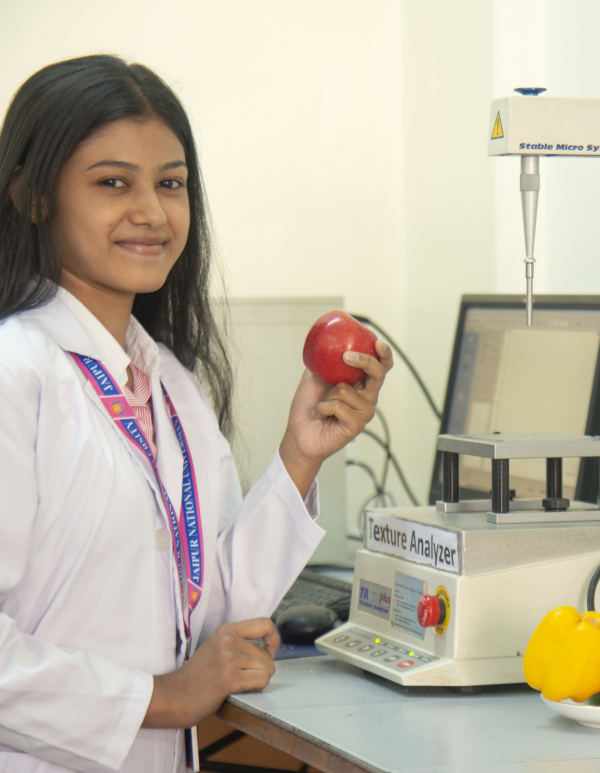
- The department has basic & advanced equipments to provide hands-on practical training tothe students
- Job-oriented four to six months Industrial Project/ Internship in the final semester of the programme
- The prevalent Government Regulations for food industries provide excellent job opportunities to the B.Tech. Food Technology graduates
- Regular Industrial visits/ Tours for better correlation of theoretical concepts with real life work situations (e.g. Parle, Britannia, PepsiCo, Coca Cola, Mother Dairy, Saras, ICAR etc)
- Industry oriented syllabus
- Regular Workshops and Guest Lectures to consolidate and update students knowledge
- Good Placement record
- Strong Alumni Links and Support
Yes, following are the cutting edge laboratories available in Department.
- Food Processing Lab
- Food Analytical Lab
- Bakery and Confectionary Lab
- Microbiology Lab
- Fluid Mechanics Lab
- Heat Transfer Lab
- Mass Transfer Lab
- Instrumentation and Process Control Lab
- Computer Lab
The major Food Processing Companies such as Perfetti India Ltd., Godrej Industries Ltd., Amul, Parle Products Pvt. Ltd., Agro Tech Foods, ITC Limited, PepsiCo India Holding, Britannia Industries Ltd., Nestle India Pvt. Ltd., Cadbury India Ltd., MTR Foods Ltd., Coca Cola Ltd., Dabur India Ltd., etc. employ Food Technologists for Jobs at various functional and managerial levels.
Choice based credit system. (Semester wise pattern)
Yes, all the faculties are highly qualified and experienced in their respective field.
Yes, class wise teacher are allotted to mentor and advise students under mentor mentee program
Yes, Department of Food Technology is having Strong Alumni Links and Support for better placements opportunities, Alumni speaker sessions, industrial tours and trainings etc.
NO. Anyone can take direct admission on the basis of JNU entrance exam
Yes, of course. JNU is offering this course for both PCB & PCM candidates.
This course helps students in all ways such as developing technical skills, soft skills, and analytical skills. It is a science which deals with the techniques and principles involved in processing and preserving the food substances. The application of food science helps in manufacturing safe, wholesome and nutritious food products. Developments in food technology have contributed greatly to the food supply and have changed our world.
The technology sector is booming and the demand for Bachelor of Technology [B.Tech] graduates are more than ever. This course is a multidisciplinary course which involves the study of Food Science, Quality, Safety, Packaging, Processing and Preservation of Food products.
It is the fastest growing branch of Engineering and Technology because there is a huge demand of packaged foods in India and abroad and hence new Food Industries are starting up year by year and therefore there is an increasing demand of Food Technology specialist in India and abroad. So it's a good decision to pursue B. Tech in Food Technology after 12th standard.
Yes, as the degree offered in B.Tech. in Food Technology. A professional in the field of Food Technology can find the employment in the field of Food manufacturing plant, research and development labs etc. People can choose the area of their working as per the interest of their subject.
There are plenty of job opportunities for food technologists in the country and abroad. Food Technology graduates can work in:
- Production and Processing: Look after the designing of plants and equipment handling in processing of food.
- Quality Assurance and Control: Ensures the quality from raw stage to finished product
- Research and Development: Conduct research on new to the world product
- Food Safety Auditing: Devoted to the chemical testing of food products
- Entrepreneurship: Self employment
- Govt. Projects and Jobs (FCI, Ag Mark, FSSAI, MoFPI, BIS, Banks etc.)
- Packaging and Printing
- Hygiene and Sanitation
- Consultancy (Plant Designing, Engineering, Safety, Quality, Certification etc.)
- Food Inspectors, Food Safety Officers: Make sure that the food products are as per the certified standards.
- Sensory Scientist: Identification of attributes that matter most to the end consumer relating to senses of sight, smell, taste & touch.
- Food Microbiologist: Makes sure that the food is fit for consumption and is free from microbial contamination.
- Nutrition and Dietician: Ensures that the food is nutritionally wholesome and in accordance to the RDA's.
- Academics and Research
During the four year course of B.Tech in Food Technology candidates study various areas such as:
- Food Science and Technology
- Food Engineering
- Food Chemistry and Nutrition
- Food Microbiology
- Food Quality and Safety
- Food Laws and Agribusiness Management
- Dairy Science
- Alcohol and Non Alcoholic beverages
- Bakery and confectionery Products
- Oil and Fats Processing Technology
- Fruits and Vegetables Products Technology
- Meat, Fish, Egg, Poultry Technology
- Cereals and Legumes Processing Technology
- Food Packaging
- Entrepreneurship
About one third of this programme involves practical experiences through Lab. practical, Industrial trainings (30-45 days), Industrial Project (4-6 months), Industrial visits, workshops, conferences etc.
The Department of Food Technology provides knowledge and training in the field of Food Engineering and Technology, to meet the requirements of technical manpower at various levels by implementing the concepts of modular systems in technical education. Salient Features of the Department are:
- The department has received financial assistance of Rs. 50 Lac from the Ministry of Food Processing Industries, Govt. of India, New Delhi, for strengthening and updating its laboratory facilities
- The department has basic & advanced equipments to provide hands-on practical training to the students
- Job-oriented four to six months Industrial Project/ Internship in the final semester of the programme
- The prevalent Government Regulations for food industries provide excellent job opportunities to the B.Tech. Food Technology graduates
- Regular Industrial visits/ Tours for better correlation of theoretical concepts with real life work situations (e.g. Parle, Britannia, PepsiCo, Coca Cola, Mother Dairy, Saras, ICAR etc)
- Industry oriented syllabus
- Regular Workshops and Guest Lectures to consolidate and update students knowledge
- Good Placement record
- Strong Alumni Links and Support
Yes, following are the cutting edge laboratories available in Department.
- Food Processing Lab
- Food Analytical Lab
- Bakery and Confectionary Lab
- Microbiology Lab
- Fluid Mechanics Lab
- Heat Transfer Lab
- Mass Transfer Lab
- Instrumentation and Process Control Lab
- Computer Lab
The major Food Processing Companies such as Perfetti India Ltd., Godrej Industries Ltd., Amul, Parle Products Pvt. Ltd., Agro Tech Foods, ITC Limited, PepsiCo India Holding, Britannia Industries Ltd., Nestle India Pvt. Ltd., Cadbury India Ltd., MTR Foods Ltd., Coca Cola Ltd., Dabur India Ltd., etc. employ Food Technologists for Jobs at various functional and managerial levels.
Choice based credit system. (Semester wise pattern)
Yes, all the faculties are highly qualified and experienced in their respective field.
Yes, class wise teacher is allotted to mentor and advise students under mentor mentee program
Yes, Department of Food Technology is having Strong Alumni Links and Support for better placements opportunities, Alumni speaker sessions, industrial tours, and trainings etc.
NO. Anyone can take direct admission based on JNU entrance exam.
Yes, of course. JNU is offering this course for both PCB & PCM candidates.


Copyright © 2026 Jaipur National University. All Rights Reserved.
Website Design and Development by Sterco Digitex


Browse by School
- School of Engineering & Technology
- School of Business & Management
- School of Computer & Systems Sciences
- School of Education
- School of Languages, Literature and Society
- School of Life & Basic Sciences
- School of Pharmaceutical Sciences
- School of Media Studies
- School of Fashion Design
- Seedling School of Law and Governance
- Seedling School of Nursing
- Seedling School of Allied and Healthcare Sciences
- School of Agricultural Sciences
- School of Hotel Management & Catering Technology
- Jaipur National University Institute for Medical Sciences and Research Centre