


- About Us
About the University
Jaipur National University, Jaipur is one of the top self-financed private university in Rajasthan sponsored by the Mahima Shiksha Samiti.

Innovation and Incubation
If you have an innovative idea, we can show you the way ahead. Be an entrepreneur with the perfect..
Social Impact/CSR
Social responsibility takes many forms - from providing affordable/free healthcare...
Why JNU?
Their focus is to develop both education and critical skills to help our students excel in life.
- Admissions
- Academics
Schools
- School of Engineering & Technology
- School of Business & Management
- School of Computer & Systems Sciences
- School of Education
- School of Languages, Literature and Society
- School of Life & Basic Sciences
- School of Pharmaceutical Sciences
- School of Media Studies
- School of Fashion Design
- Seedling School of Law and Governance
- Seedling School of Nursing
- Seedling School of Allied and Healthcare Sciences
- School of Agricultural Sciences
- School of Hotel Management & Catering Technology
- Jaipur National University Institute for Medical Sciences and Research Centre
- Research
- Campus Life
Enriching the Intellect

Inspire Your Essence
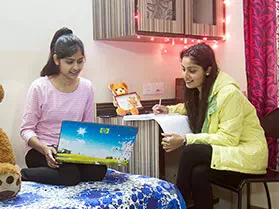
Outside the classroom

Adapt to Physical Wellness

-

 Admission HelpDesk


-
Duration
4 Years
-
Eligibility
Min.50% Aggregate in 10+2 with Physics and Mathematics as Compulsory Subjects.
-
Selection Procedure
Joint Entrance Examination (JEE) or University Entrance Test and Personal Interview (ET+PI)
Program Outcomes
Engineering Knowledge
Apply the knowledge of mathematical, scientific and engineering fundamentals in formulating and solving engineering problems.
Problem Analysis
Identify, analyze and provide substantial conclusions for complex engineering problems using mathematics, natural sciences, and engineering sciences.
Design/Development of Solutions
Design appropriate solutions for complex engineering problems towards meeting societal needs.
Conduct Investigations of Complex Problems
Use research-based knowledge and research methods including design of experiments, analysis and interpretation of data and synthesis of the information to provide valid conclusions.
Modern Tool Usage
Apply modern tools and techniques for prediction and modeling of complex engineering activities with an understanding of the limitations.
The Engineer and Society
Apply reasoning informed by the contextual knowledge through good analytical design and implementing the skills in the industries, government, academia, research and consulting sectors.
Environment and Sustainability
Understand the impact of the professional engineering solutions in societal and environmental contexts, and demonstrate the knowledge of, and need for sustainable development.
Ethics
Apply ethical principles to work effectively and conduct themselves ethically in their professional environment.
Individual and Team Work
Work competently as an individual or in a team in one or more core areas of engineering and technology.
Communication
Communicate effectively on engineering activities to understand, write and present reports.
Project Management and Finance
Demonstrate knowledge and understanding of the engineering and management principles and apply these to one’s own work, as a member and leader in a team, to manage projects and in multidisciplinary environments.
Life-long Learning
Recognize the need for, and have the preparation and ability to engage in independent and life-long learning in the broadest context of technological change.
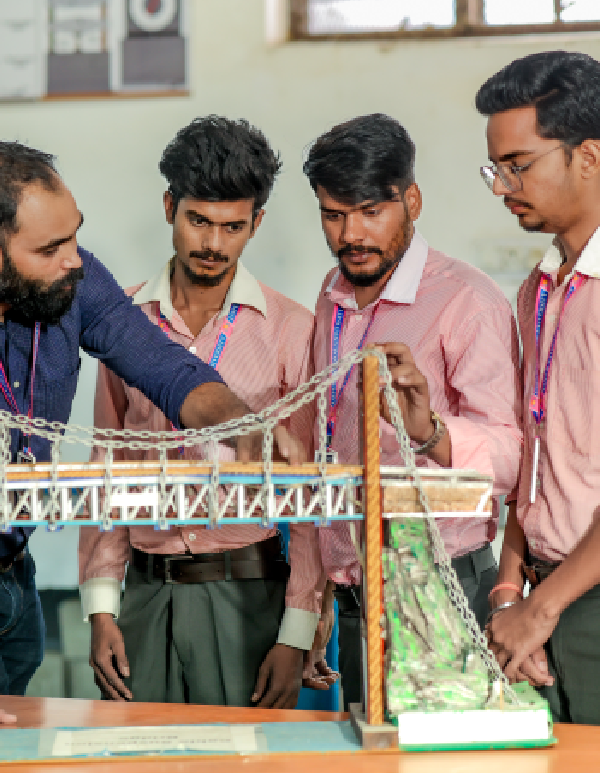
Career Paths

Civil Engineer

Geo-technical Engineer

Water Resource Engineer

Construction Manager

Environmental Engineer

Construction Engineers

Water Resources Engineers

Structural Engineers

Urban and Regional Planners
Curriculum
| Course Category | Paper Title | Credits |
|---|---|---|
| Core | Engineering Graphics and Visualization | 3 |
| Core | Engineering Chemistry | 3 |
| Core | Engineering Mathematics I | 4 |
| Core | Engineering Graphics and Visualization Lab | 1 |
| Core | Engineering Chemistry Lab | 1 |
| DSE | Fundamental of Electrical and Electronics | 2 |
| Fundamental of Electrical and Electronics Lab | 1 | |
| OR | ||
| Introduction to Computer Application Lab | 1 | |
| AECC | English | 3 |
| Language Lab | 1 | |
| AUC# | Sports/Yoga/NSS/NCC | 1# |
| Total | 23 | |
# Audit but Mandatory Course
| Course Category | Paper Title | Credits |
|---|---|---|
| Core | Programming for Problem Solving using C | 3 |
| Core | Engineering Physics | 3 |
| Core | Engineering Mathematics II | 4 |
| Core | Programming for Problem Solving Lab | 2 |
| Core | Engineering Physics Lab | 1 |
| SEC | Design Thinking | 1 |
| SEC | Design Thinking & Idea Lab | 1 |
| DSE | Engineering Mechanics | 3 |
| OR | ||
| Smart and Sustainable Energy | 3 | |
| AECC | Communication and Soft Skills Lab | 2 |
| VAC# | Environmental Science | 2# |
| Total | 25 | |
# Audit but Mandatory Course
| Course Category | Course Name | Credits |
|---|---|---|
| Core | Fluid Mechanics | 3 |
| Core | Surveying and Geomatics-I | 3 |
| Core | Strength of Material | 4 |
| Core | Mathematics-III | 4 |
| Core | Fluid Mechanics Lab | 2 |
| Core | Surveying –I Lab | 2 |
| Core | Material Testing Lab | 1 |
| Core | Computer Aided Civil Engineering Drawing | 1 |
| DSE | Civil Engineering Material | 3 |
| Renewable Energy Resources | ||
| OE* | Open Elective* | 2 |
| Extra-Curricular Activity | **Mandatory Qualifying Non-credited but graded Course | |
| Total | 25 |
*Students can choose any one subject from the pool of Open Elective Courses
**Mandatory Qualifying Non-credited but graded Course.
| Course Category | Course Names | Credits |
|---|---|---|
| CORE | Concrete Technology | 3 |
| CORE | Structural Analysis-I | 4 |
| CORE | Surveying and Geomatics-II | 3 |
| CORE | Environmental Engineering-I | 4 |
| CORE | Concrete Technology Lab | 2 |
| CORE | Structural Analysis Lab | 1 |
| CORE | Surveying –II Lab | 2 |
| CORE | Environmental Engineering -I Lab | 1 |
| DSE | Hydraulics and Hydraulic Machines | 3 |
| GIS and Remote Sensing | ||
| OE* | Open Elective* | 2 |
| Co-Curricular Activity | **Mandatory Qualifying Non-credited but graded Course | |
| Total | 25 |
*Students can choose any one subject from the pool of Open Elective Courses
**Mandatory Qualifying Non-credited but graded Course
| Course Category | Course Names | Credits |
|---|---|---|
| CORE | Geotechnical Engineering –I | 3 |
| CORE | Structural Analysis –II | 4 |
| CORE | Transportation Engineering- I | 3 |
| CORE | Environmental Engineering-II | 4 |
| CORE | Geotechnical Engineering –I Lab | 2 |
| CORE | Transportation Engineering-I Lab | 1 |
| CORE | Environmental Engineering –II Lab | 1 |
| CORE | Engineering Geology | 1 |
| DSE | Engineering Hydrology | 3 |
| Quantity Surveying and Estimating | ||
| OE* | Open Elective* | 2 |
| Total | 24 |
*Students can choose any one subject from the pool of Open Elective Courses
**Mandatory Qualifying Non-credited but graded Course
| Course Category | Course Names | Credits |
|---|---|---|
| CORE | Water Resource Engineering-I | 4 |
| CORE | Design of Concrete Structure-I | 4 |
| CORE | Design of Steel Structure-I | 4 |
| CORE | Geotechnical Engineering-II | 3 |
| CORE | Water Resource Engineering-I Lab | 1 |
| CORE | Design of Concrete Structures-I Lab | 1 |
| CORE | Design of Steel Structures –I Lab | 1 |
| CORE | Geotechnical Engineering-II Lab | 2 |
| DSE | Transportation Engineering-II | 3 |
| Ground Improvement Techniques | ||
| OE | Open Elective* | 2 |
| Total | 25 |
*Students can choose any one subject from the pool of Open Elective Courses
**Mandatory Qualifying Non-credited but graded Course
| Course Category | Course Titles | Credits |
|---|---|---|
| CORE | Water Resource Engineering-II | 4 |
| CORE | Design of Concrete Structure-II | 4 |
| CORE | Design of Steel Structure-II | 3 |
| CORE | Construction Planning and Management | 3 |
| CORE | Water Resource Engineering-II Lab | 1 |
| CORE | Design of Concrete Structure-II Lab | 1 |
| CORE | Design of Steel Structure-II Lab | 1 |
| CORE | Summer Training Seminar | 1 |
| CORE | Project | 2 |
| DSE | Geotechnical Earthquake Engineering | 3 |
| Advance Foundation Engineering | ||
| OE | Open Elective | 2 |
| Total | 25 |
| Duration | Category | Credits |
|---|---|---|
| Industrial training and Project work (4-6 Months) | Dissertation (Valuation by Internal Examiner) | 08 |
| Dissertation (Valuation by External Examiner) | ||
| Presentation | ||
| Defense | ||
| Total | 08 |
Tuition Fee
₹1,09,100
Note
*Lab & Library fee will be charged separately
#Program Proposed from Session 2026-27

Apply for admissions at Jaipur National University
APPLY ONLINE 1800-102-1900
  admissions@jnujaipur.ac.in
 Internship Opportunities





Engage, Connect and Experience
the vibrant Life at JNU
Acres Green
Campus
State-of-the-Art
Labs
Smart
Classrooms
Signature Annual
Events
Student
Clubs

Enriching the
Intellect


Inspire Your
Essence






Frequently Asked Questions
Civil engineering is a professional engineering discipline that deals with the design, construction, and maintenance of the physical and naturally built environment, including public works such as roads, bridges, canals, dams, airports, sewerage systems, pipelines, structural components of buildings, and railways.
Civil engineering is the application of physical and scientific principles for solving the problems of society, and its history is intricately linked to advances in the understanding of physics and mathematics throughout history. Civil Engineering is a wide-ranging profession, including several specialized sub-disciplines, its history is linked to knowledge of structures, materials science, geography, geology, soils, hydrology, environment, mechanics and other fields.
Infrastructure Engineering and Construction Management engineering helps the students to learn about construction of the building, townships, roads, bridges and transportation. Infrastructure engineers do this work through designing, proper planning and use of the environment management techniques. The program of Infrastructure engineering produces highly skilled construction and project management engineers. These engineers are well aware of the planning and designing of the project, cost estimation and execution of the project.
M.Tech. in Water Resources Engineering is a 2- year, full- time specialized course divided into 4 semesters. Water Resources Engineering is a specialty of civil engineering that focuses on water supplies, irrigation and waste disposal. It also addresses methods for controlling water to avoid water-related damage and catastrophes. It also deals with the optimization of system with various components of resources like irrigation, dams and reservoirs.
M.Tech. in Structural Engineering involves advanced study of the course’s components such as Structural Mechanics, Finite Element Analysis, Structural Dynamics, Structural Reliability and Optimization, Reinforced and Pre-Stressed Concrete, Steel Structures, Design for Wind and Earthquake, Tall Buildings And Towers, Computer Applications In Structural Engineering, etc.
Diploma in Civil Engineering is a 3-year long course in engineering, specializing in the design, construction, and maintenance of physical and naturally-built environment, such as roads, bridges, irrigation, environmental engineering, elements of structures, canals, dams and buildings. The minimum eligibility criterion required for the candidates is to pass 10 th grade with minimum 50% marks.
Civil Engineering is a professional engineering discipline and the oldest which deals with the constructed environment.Civil Engineers are the reason behind all those towering buildings, highways and bridges railways, dams, irrigations ,water supply,that we witness in our day to day lives. Other avenues of civil engineering workplaces include road construction, building construction, township planning, metro construction, among various others.
There are plenty of opportunities in government, government undertakings and private organisation like:
- Site Engineer.
- Construction Civil Engineer.
- Project Manager.
- Assistant Civil Engineer.
- Assistant Project Manager.
- Planning and Design Officer.
- Purchase and Quality Control Executive.
- As a consultants
- Contractors
- Entrepreneurs
The students will acquire the knowledge and necessary skills sets, like: Project Management, Business Management, Construction Sustainability Behavioural, Aspects of the projects.
The core subjects of civil Engineering include the following subjects:
- Surveying-land and surveying
- Material science and engineering
- Steel Structure engineering
- Construction Engineering
- Building Technology
- Structural Analysis & Design
- Design of Hydraulic Structures
- Earthquake Engineering
- Environmental Engineering
- Water resources Engineering
- Geotechnical Engineering
- Transportation Engineering
40% of the time involves practical sessions through laboratory practical, summer industrial training (30-40%), industrial project internships (4-6 months), industrial visit, workshops, conferences etc.
Department of civil engineering provides knowledge and training in the field of civil engineering, to meet the requirement of technical man power at various levels by implementing the concept of popular system in technical education. Salient features of department are: The department has academic tie up, through the school of engineering and technology and building designing and infrastructure development projects software hub.
The department has academic tie up, through the school of engineering and technology, with CADD, STADD PRO, E TABS, and REVIT COURSES AND TRAINING
The department has dedicated laboratories for the environment, geotechnical, road testing material testing, surveying lab, concrete lab, structural Engineering lab to provide hand on practical training to the students.
The pc student ration is 1:1 with high speed Giga width internet supported by national knowledge network
Job oriented 4 -6 months industrial project/ internship in the final semester of the program The digital India mission of the government of the India along with booming startup space provide excellent job opportunities to the B.Tech. civil engineering graduates.
The regular industrial visits/ tours for better co- relation of theoretical concepts with real life work situation. (E.g. JP GROUPS, SHRI CEMENT, ANSAL GROUP, AMRAPALI, DLF, L&T etc.)
Industry oriented syllabus
Regular workshops and guest lectures to consolidate and update students’ knowledge
Good placement records
Strong alumni links and supports
- Following are the cutting edge laboratories available in department
- Environmental Engineering Lab
- Survey Engineering
- RMT Lab
- Geotechnical Lab
- ConcreteLab
- Material Testing Lab
- Structural Lab
- Fluid Mechanics Lab
There are the companies such as LARSEN AND TOUBRO, DLF, AMRAPALI, SINGLA GROUP, JP GROUPS, RELIANCE GROUP OF INFRASTURE, SHRI CEMENT, ANSAL group ETC. HAVE STUDENTS FROM JNU At various functional and material levels.
Choice base credit system (semester wise pattern)
We have large number of high qualified faculty in civil engineering with rich industry experience and they have spent significant time in such different fields of Civil Engineering like Structures, Geo-specialized, Environmental, Transportation, Fluid Mechanics and Water Resource Engineering.
The mentor as a guide offers supportive exhortation on how educators, executives, and vocation counselors in science and designing can turn out to be better tutors to their understudies. Mentors to each section help them take full advantage of their instructive experience, by acquainting them with and making them alright with a particular disciplinary culture, and by offering help with the quest for appropriate business. Different themes shrouded in the guide incorporate vocation arranging, time the executives, composing advancement, and dependable logical lead. Likewise included is a significant rundown of bibliographical and Internet assets on tutoring and related points.
The reason for the Civil Engineering Alumni Association (CEAA) is to dedication and pride among graduated class and companions by creating and upgrading their proceeded with relationship with the office.. Our graduated class and companions effectively bolster the office by:
- Tutoring understudies
- Introducing classes
- Addressing classes
- Going to understudy supported exercises
- Supporting understudy associations
Any one can take direct admission through JNU entrance exam JNU-JEST 2020. And there is a interview also.
Training and Placement Cell has organized more than 50 on campus placement drives, off- campus and pool-campus placement drives for our Civil engineering 2019 passing students. And 40+ companies that gave placement offers to more than 65 students .Average offered was 2.75 LPA (lakh Rupees per annum) with highest going up to 5.10 LPA. Many of our students received multiple job offers from different companies
Civil engineering is the discipline dedicated to designing, building, and maintaining infrastructure, including structures like buildings, roads, bridges, dams, and water supply systems.
The main branches include structural, environmental, transportation, geotechnical, water resources, construction, and urban planning engineering.
Civil engineers design, plan, and oversee construction projects, ensuring they are safe, sustainable, and meet regulatory standards.
Key skills include mathematics, physics, project management, problem-solving, proficiency with design software (such as AutoCAD), and excellent communication skills.
Structural engineering is a branch of civil engineering focused on ensuring structures are safe, stable, and capable of withstanding environmental and load forces.
Civil engineers utilize software for design (Auto CAD, Revit), analysis (STAAD.Pro, SAP2000), project management (Primavera, MS Project), and simulations.
Sustainable building focuses on using environmentally friendly materials and designs to minimize the environmental impact of structures, while improving energy efficiency and conserving resources.
A bachelor's degree in civil engineering is usually required. Professional licensure and advanced specialization may necessitate additional exams and experience.


Copyright © 2026 Jaipur National University. All Rights Reserved.
Website Design and Development by Sterco Digitex


Browse by School
- School of Engineering & Technology
- School of Business & Management
- School of Computer & Systems Sciences
- School of Education
- School of Languages, Literature and Society
- School of Life & Basic Sciences
- School of Pharmaceutical Sciences
- School of Media Studies
- School of Fashion Design
- Seedling School of Law and Governance
- Seedling School of Nursing
- Seedling School of Allied and Healthcare Sciences
- School of Agricultural Sciences
- School of Hotel Management & Catering Technology
- Jaipur National University Institute for Medical Sciences and Research Centre