


- About Us
About the University
Jaipur National University, Jaipur is one of the top self-financed private university in Rajasthan sponsored by the Mahima Shiksha Samiti.

Innovation and Incubation
If you have an innovative idea, we can show you the way ahead. Be an entrepreneur with the perfect..
Social Impact/CSR
Social responsibility takes many forms - from providing affordable/free healthcare...
Why JNU?
Their focus is to develop both education and critical skills to help our students excel in life.
- Admissions
- Academics
Schools
- School of Engineering & Technology
- School of Business & Management
- School of Computer & Systems Sciences
- School of Education
- School of Languages, Literature and Society
- School of Life & Basic Sciences
- School of Pharmaceutical Sciences
- School of Media Studies
- School of Fashion Design
- Seedling School of Law and Governance
- Seedling School of Nursing
- Seedling School of Allied and Healthcare Sciences
- School of Agricultural Sciences
- School of Hotel Management & Catering Technology
- Jaipur National University Institute for Medical Sciences and Research Centre
- Research
- Campus Life
Enriching the Intellect

Inspire Your Essence

Outside the classroom

Adapt to Physical Wellness

-

 Admission HelpDesk



-
Duration
4 Years
-
Eligibility
Min.50% Aggregate in 10+2 with Physics and Mathematics as Compulsory Subjects.
-
Selection Procedure
Joint Entrance Examination (JEE) or University Entrance Test and Personal Interview (ET+PI)
Program Outcomes
Design and Analyze Systems
Apply engineering principles and mathematics to design, develop, and analyze electronic and communication systems.
Adapt to New Technologies
Stay up to date with new technologies and develop solutions for existing and new problems.
Apply Knowledge
Apply knowledge of engineering fundamentals, mathematics, science, and engineering specialization to solve complex engineering problems.
Design Solutions
Design solutions for complex engineering problems while considering public health and safety, as well as cultural, societal, and environmental factors.
Conduct Investigations
Use research-based knowledge and methods to investigate complex problems and provide valid conclusions.
Develop Technical Skills
Use cutting-edge software and hardware tools to design and implement products.
Demonstrate Leadership
Demonstrate leadership qualities and strive to improve the organization, environment, and society.
Develop Interpersonal Skills
Develop interpersonal skills such as communication, listening, presentation, team building, and assertiveness, with a professional attitude.
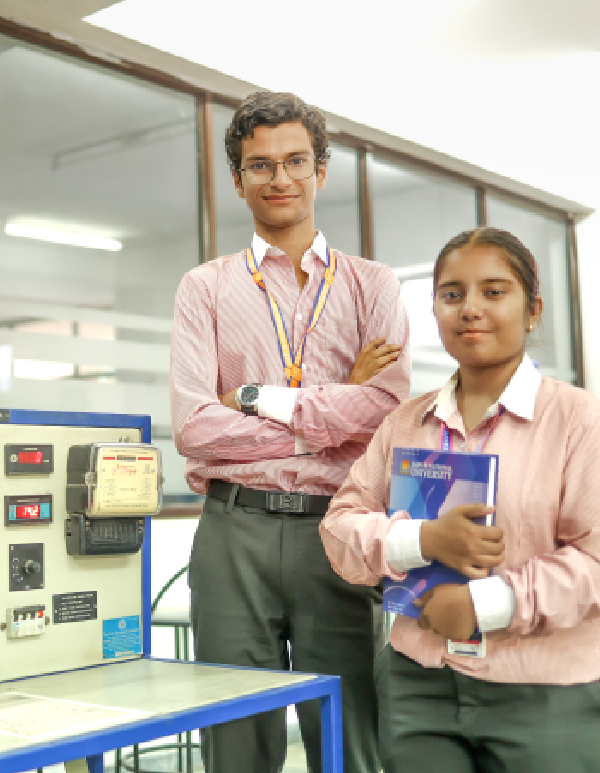
Career Paths

Design Engineer

Testing and Validation Engineer

Field Engineer

Project Engineer/Manager

Research and Development Engineer

Application Engineer

Senior Engineer/Lead Engineer

Technical Manager

Product Manager

Higher Education and Research

Entrepreneur
Curriculum
| Course Category | Paper Title | Credits |
|---|---|---|
| Core | Engineering Graphics and Visualization | 3 |
| Core | Engineering Chemistry | 3 |
| Core | Engineering Mathematics I | 4 |
| Core | Engineering Graphics and Visualization Lab | 1 |
| Core | Engineering Chemistry Lab | 1 |
| DSE | Fundamental of Electrical and Electronics | 2 |
| Fundamental of Electrical and Electronics Lab | 1 | |
| OR | ||
| Introduction to Computer Science | 2 | |
| Introduction to Computer Application Lab | 1 | |
| AECC | English | 3 |
| Language Lab | 1 | |
| AUC# | Sports/Yoga/NSS/NCC | 1# |
| Total | 19 | |
# Audit but Mandatory Course
| Course Category | Paper Title | Credits |
|---|---|---|
| Core | Programming for Problem Solving using C | 3 |
| Core | Engineering Physics | 3 |
| Core | Engineering Mathematics II | 4 |
| Core | Programming for Problem Solving Lab | 2 |
| Core | Engineering Physics Lab | 1 |
| SEC | Design Thinking | 1 |
| SEC | Design Thinking & Idea Lab | 1 |
| DSE | Engineering Mechanics | 3 |
| OR | ||
| Smart and Sustainable Energy | 3 | |
| AECC | Communication and Soft Skills Lab | 2 |
| AUC# | Environmental Science | 2# |
| Total | 20 | |
# Audit but Mandatory Course
| Course Category | Paper Title | Credits |
|---|---|---|
| CORE | Electronic Devices | 3 |
| CORE | Digital System Design | 3 |
| CORE | Mathematics – III (Probability and Statistics) | 3 |
| CORE | Data Structure & Algorithms | 3 |
| CORE | Electronic Devices Lab | 1 |
| CORE | Digital System Design Lab | 1 |
| CORE | Professional Practices-I Lab | 1 |
| CORE | Data Structure & Algorithms Lab | 1 |
| DSE | Signals & Systems | 3 |
| Network Theory | ||
| OE* | Open Elective* | 2 |
| Extra-Curricular Activity | Mandatory Qualifying Non-credited but graded Course | |
| Total | 21 |
*Students can choose any one subject from the pool of Open Elective Courses
**Mandatory Qualifying Non-credited but graded Course
| Course Category | Paper Title | Credits |
|---|---|---|
| CORE | Analog and Digital Communication | 3 |
| CORE | Analog Circuits | 3 |
| CORE | Microprocessor and Microcontrollers | 3 |
| CORE | Object Oriented Programming | 3 |
| CORE | Analog and Digital Communication Lab | 1 |
| CORE | Analog Circuits Lab | 1 |
| CORE | Microprocessor & Microcontroller Lab | 1 |
| CORE | Object Oriented Programming Lab | 1 |
| DSE | Electromagnetic Field Theory | 3 |
| Probability Theory and Stochastic Processes | ||
| OE* | Open Elective* | 2 |
| Co-Curricular Activity | Mandatory Qualifying Non-credited but graded Course | |
| Total | 21 |
*Students can choose any one subject from the pool of Open Elective Courses
**Mandatory Qualifying Non-credited but graded Course
| Course Category | Paper Title | Credits |
|---|---|---|
| Core | Electromagnetic Waves | 3 |
| Core | Digital Signal Processing | 3 |
| Core | Organizational Behaviour | 3 |
| Core | Electronic Material Processes | 3 |
| Core | Electromagnetic Waves Lab | 1 |
| Core | Digital Signal Processing Lab | 1 |
| Core | Internship Program Seminar | 1 |
| Core | Minor Project Lab-I | 1 |
| DSE | Nano Electronics | 3 |
| Optimization Techniques | ||
| SEC | PCB Design and Fabrication | 2 |
| GE* | Generic Elective* | 2 |
| Total | 23 |
| List of Generic Electives |
|---|
| Fundamentals of IoT |
| Fundamentals of Robotics |
| Introduction to Embedded Systems Design |
| Course Category | Paper Title | Credits |
|---|---|---|
| Core | Control Systems | 3 |
| Core | Computer Network | 3 |
| Core | VLSI Design | 3 |
| Core | Information Theory & Coding | 3 |
| Core | Computer Networks Lab | 1 |
| Core | Electronic Measurement Lab | 1 |
| Core | Electronics CAD Laboratory | 1 |
| Core | Minor Project Lab-II | 1 |
| DSE | Introduction to MEMS | 3 |
| Marketing for Engineers | ||
| SEC | Arduino Programming & Applications | 2 |
| GE* | Generic Elective* | 2 |
| Total | 23 |
| List of Generic Electives |
|---|
| Sensors transducers and Actuators |
| Drives and Control System for Robotics |
| Microcontroller for Embedded System Design |
| Course Category | Paper Title | Credits |
|---|---|---|
| Core | Microwave Theory and Techniques | 3 |
| Core | Fiber Optic Communications | 3 |
| Core | VHDL | 3 |
| Core | Antennas and Propagation | 3 |
| Core | Microwave Lab | 1 |
| Core | Fiber Optic & Mobile Communication Lab | 1 |
| Core | Industrial Economics & Management Lab | 1 |
| Core | Major Project Lab | 1 |
| Core | Industrial Training | 1 |
| DSE | Mobile Communication and Networks | 3 |
| Artificial Intelligence Techniques | ||
| GE* | Generic Elective* | 2 |
| Total | 22 |
| List of Generic Electives |
|---|
| Wireless Sensors Networks |
| Robot Programming and Intelligent Control System |
| Digital System Design |
| Course Category | Paper Title | Credits |
|---|---|---|
| CORE | Industrial Project | 15 |
| Total | 15 |
Tuition Fee
₹1,09,100
Note
*Lab & Library fee will be charged separately
#Program Proposed from Session 2026-27

Apply for admissions at Jaipur National University
APPLY ONLINE 1800-102-1900
  admissions@jnujaipur.ac.in
 Internship Opportunities









Engage, Connect and Experience
the vibrant Life at JNU
Acres Green
Campus
State-of-the-Art
Labs
Smart
Classrooms
Signature Annual
Events
Student
Clubs

Enriching the
Intellect


Inspire Your
Essence





Frequently Asked Questions
B. Tech in Electronics and Communication (ECE) is a four-year undergraduate programme focused on utilising science to solve practical problems in the field of devices &communications. Broadly, the programme intends to inculcate an in-depth understanding of signals, circuits and software development for developing excellent Electronics and Communication products and devices.Progressively the programme deals with subjects like devices, digital Communication and job-related skill enhancement.
Yes, the most important benefits that Electronics and Communication branch provides you is freedom. the freedom to drift between hardware field and software development. Furthermore, this is also the reason that a lot of industries choose to prefer Electronics and Communications engineers over other engineers.An Electronics and Communication Engineer, who has knowledge about the hardware domain, and also has a grip over computer programming, will be more successful than another student who are proficient only in the software field.
Taking the educational scope and career choices into consideration, here are the popular areas of study in the field of Electronics and Communication.
- Embedded System: Embedded Systems are one of the leading specializations in the field of Electronics and Communications. These systems are a combination of hardware and software.Leading Companies like, Intel, IBM, Philips, Motorola, LG Electronics, Texas Instruments, VOLVO, Freescale and many more
VLSI Design: It is the most widely used technology for Integrated Circuits (ICs), Microchips, and Component designing. An Acronym for Very Large-Scale Integration.
Leading Companies: Honeywell India, Intel, ST Microelectronics, Samsung, National Semiconductor, Micron Technology, Qualcomm, Texas Instruments, and all IC design manufacturing companies (Location, Noida, Banglore, Hyderabad, Pune etc)
- Wireless Communication: Wireless Communications play a significant role in our daily lives. This type of Communication incorporates the techniques of communication between two or more systems without any physical medium or channel. A great example is mobile communication &Wi-Fi. Some of the important types of Wireless communication are, Satellite Communication, Microwave Communication., Radio Communication and Mobile Communication. Leading Companies or related institutions: ISRO, JIO, Airtel, Vodaphone, NASA, Indian Railway, ATC (Airport) etc.
- Robotics: Another important branch of Electronics and Communication is Robotics. This field deals with the construction, utilization, and control of machines that can replicate human motions. Robots are machines that are used to substitute human labor for various task Job: All robotics companies, a great example Sophia Robot, it is a social humanoid robot developed by Hong Kong based company Hanson Robotics.
- Image Processing: Digital Image Processing is the discipline that deals with the processing of digital images with the help of computer algorithms. Companies: Google, Facebook, Twitter or any related companies, those deals with Images.
- Internet of Things: The Internet of things (IoT) is a system of interrelated computing devices, mechanical and digital machines provided with unique things and the ability to communicate over a network without requiring human-to-human or human-to-computer interaction. IoT is upcoming leading technology.
Yes, following are the names of the organization, specially asked for electronics engineers. To get a career in the Public Sector Undertaking(PSUs), students need to clear Gate and followed by an interview.
- ISRO (Indian Space Research Organization).
- ECIL (Electronics Corporation of India Limited).
- BARC (Bhabha Atomic Research Centre).
- DRDO (Défence Research and Development Organization).
- BEL (Bharat Electronics Limited).
- DERL (Défence Electronics and Research Laboratory.)
- BHEL (Bharat Heavy Electricals Limited).
- HAL (Hindustan Aeronautics Limited).
- Indian Railway
Electronics Devices, Digital Electronics, Digital Communication, VLSI Design, IC Technology, Satellite Communication, Embedded System,Programming languages, Embedded System, Digital Image Processing, Machine Leaning (as Elective), Data Science (as Elective), etc.
The Department of Electronics provides knowledge and training in the field of electronics and communication engineering, to meet the requirements of technical manpower at various levels by implementing the concepts of modular systems in technical education. Salient Features of the Department are:
- The department has academic tie-up, through the School of Engineering & Technology, with Myongji University, South Korea, CSIR_CEERI Pilani, Govt of India, Sambhav Electronics, Noida for providing summer training and internships to our students.
- The department has well equipped research and development lab specially for project development.
- The department has dedicated laboratories for project development, Analog ElectronicsLab, Devices Lab, Microwave Lab, CAD Lab (Software), and MicroprocessorLab to provide hands-on practical training to the students
- The PC to student ratio is 1:1, with high-speed gigabit Internet supported by national Knowledge Network
- Job-oriented four to six months Industrial Project/ Internship in the final semester of the programme
- The Digital India mission of the Government of India along with booming start-up space provide excellent job opportunities to the B.Tech. ECE graduates
- Regular Industrial visits/ Tours for better correlation of theoretical concepts with real life work situations (e.g. HCL, CEERI, Omega Electronics, etc.)
- Industry oriented syllabus
- Regular Workshops and Guest Lectures to consolidate and update students’ knowledge
- Good Placement record
- Strong Alumni Links and Support
Yes, following are the cutting-edge laboratories available in Department.
- R & D Lab for research and development
- CAD Lab for model development and verification
- Microwave Engineering Lab.
- Microprocessor Lab
- Computer Lab (For Software related work)
- Electronic Devices & Circuits Lab
- Basic Electronics Lab
- Network Lab
- Digital Electronics Lab
- Digital Communication Lab
The major electronics companies such as Intel, Honeywell, Airtel, Amazon, Synopsys Technology, Reliance Jio, Philips, Indian Army, Indian Railway, BSNL, Wipro, HCL, ST Microelectronic, Samsung, National Semiconductor, etc. have students from JNU at various functional and managerial levels.
Choice based credit system. (Semester wise pattern)
Yes, all the faculty members are highly qualified with rich Industry and academic experience in their respective fields.
Yes, class wise teacher is allotted as mentors to advise the students under the mentor-mentee program
Yes, the Electronics Department has a thriving Alumni network that is very active and supports in better placements opportunities. We also organize Alumni speaker sessions, industrial tours and trainingsetc.
No, apart from JEE Main score, student having eligibility criteria can take admission on the basis of JNU entrance exam JNU-JEST 2020. This test is optional it you have taken JEE.
No. Either PCM or Physics, Maths, Computer can take the admission.
The T & P Cell organized more than 40 on-campus, off-campus and pool-campus placement drives for our students on 2019 passing batch. There was 30+ companies that gave placement offers to more than 68% students of the 2019 batch. The average package offered was 3.00 LPA (lakh Rupees per annum) with highest package going up to 5.00 LPA. Many of our students received multiple job offers from different companies.
Electronics and Communication Engineering is a branch of engineering that focuses on the design, development and maintenance of electronic devices and communication systems. It encompasses a wide range of technologies, including microelectronics, telecommunication systems, signal processing, and more.
ECE engineers work on designing and developing electronic circuits, communication systems, and devices. They may also be involved in troubleshooting and maintaining existing systems, improving network infrastructure, and researching new technologies.
Core subjects in ECE typically include digital electronics, analog electronics, communication systems, electromagnetic theory, microprocessors, control systems, and signal processing. Along with these courses, department of ECE offers electives from the domain of CSE and EE where individual can gain knowledge of cutting edge technologies.
Key skills for ECE students include proficiency in programming languages like C/C++, MATLAB, problem-solving skills, understanding of circuit design, knowledge of communication protocols, and the ability to work with complex systems.
Yes, ECE is a dynamic field with constant technological advancements. Keeping up-to-date with the latest developments is essential for ECE professionals.
Emerging trends in ECE include the Internet of Things (IoT), 5G and beyond, artificial intelligence and machine learning applied to communications and renewable energy systems.
Yes, internships and practical experience are crucial for ECE students to apply theoretical knowledge in real-world scenarios, gain practical skills, and enhance their employability.
Professional organizations like the Institute of Electrical and Electronics Engineers (IEEE) and the Electronics and Telecommunication Engineers Association (ETA) offer networking opportunities, resources, and conferences for ECE professionals.
The future prospects for ECE professionals are promising, as technology continues to advance. They can expect opportunities in fields like wireless communication, robotics, IoT, and renewable energy systems. Remember that the field of Electronics and Communication Engineering is diverse, and career paths can vary widely based on individual interests and specialization within the field.
Yes, multiple Scholarship schemes are offered by Jaipur National University. Candidates may avail scholarships basis of percentage marks secured in XII Class. Application for the same may be made according to University norms with supporting documents and certificates.
The eligibility criteria is 50% marks in 10+2 with PCM as mandatory subjects and one addition subject. Students appearing in qualifying examination in the coming year may also apply. Their admission shall however be provisional, subject to confirmation upon obtaining qualifying marks for admission which is at least 50%.
The Department has strong interaction with industries and the students are exposed to the cutting-edge technologies applied in industries by way of internships, in-plant trainings, guest lecturers from corporate persons and industrial visits.
The Department has distinguished faculty, with M.Tech and Ph.D. degrees from renowned institutes. The major research areas are optical fiber communication, Antenna design and Fabrication, Signal Processing & Communication, RF & Microwave Engineering, VLSI Design, Embedded systems Design, Controls & Instrumentation.
The teaching methodology adopted by the Department is complete synergy with the latest and evolving market challenges and trends. We follow highly interactive, student-centric, and innovative teaching methodologies that emphasize on learning by experimenting and experiencing to groom future technical leaders and managers. These include case studies, audio-visual presentations, group discussions, role-plays, brainstorming, industrial visits, symposia, seminars, projects, quizzes, and special lectures of experts from the corporate. Adequate focus is given on enhancing analytical powers, Computational skills, problem-solving strategies, and team spirit. A rich association of the best industry professionals and highly competent faculty members, thrust towards the practical orientation backed with a thorough theoretical base.
In the tougher times of Covid-19,the department immediately shifted to the online mode ,engaging through various platforms like Zoom, Google Classroom, MS Team. The internal and final examination was also conducted on various online platforms.
The department has state of the art, modern and well-equipped Laboratories with adequate facilities. Classrooms are fitted with the latest equipment for making presentations, lectures, debates and group discussions take place in the most convenient and enriching way. Students get all the ICT (Information and Communication Technologies) support in their Smart Classrooms and are encouraged to perform as digital learners. The latest technology with Interactive Boards and Projectors is extensively used in the classroom to benefit young learners.


Copyright © 2026 Jaipur National University. All Rights Reserved.
Website Design and Development by Sterco Digitex


Browse by School
- School of Engineering & Technology
- School of Business & Management
- School of Computer & Systems Sciences
- School of Education
- School of Languages, Literature and Society
- School of Life & Basic Sciences
- School of Pharmaceutical Sciences
- School of Media Studies
- School of Fashion Design
- Seedling School of Law and Governance
- Seedling School of Nursing
- Seedling School of Allied and Healthcare Sciences
- School of Agricultural Sciences
- School of Hotel Management & Catering Technology
- Jaipur National University Institute for Medical Sciences and Research Centre