


- About Us
About the University
Jaipur National University, Jaipur is one of the top self-financed private university in Rajasthan sponsored by the Mahima Shiksha Samiti.

Innovation and Incubation
If you have an innovative idea, we can show you the way ahead. Be an entrepreneur with the perfect..
Social Impact/CSR
Social responsibility takes many forms - from providing affordable/free healthcare...
Why JNU?
Their focus is to develop both education and critical skills to help our students excel in life.
- Admissions
- Academics
Schools
- School of Engineering & Technology
- School of Business & Management
- School of Computer & Systems Sciences
- School of Education
- School of Languages, Literature and Society
- School of Life & Basic Sciences
- School of Pharmaceutical Sciences
- School of Media Studies
- School of Fashion Design
- Seedling School of Law and Governance
- Seedling School of Nursing
- Seedling School of Allied and Healthcare Sciences
- School of Agricultural Sciences
- School of Hotel Management & Catering Technology
- Jaipur National University Institute for Medical Sciences and Research Centre
- Research
- Campus Life
Enriching the Intellect

Inspire Your Essence
Outside the classroom

Adapt to Physical Wellness
-

 Admission HelpDesk



Bachelor of Medical Laboratory Science (BMLS)
BMLS
Seedling School of Allied and Healthcare Sciences
APPLY ONLINE-
Duration
4 Years i.e 8 semesters (including 1 year of clinical training /internship)
-
Eligibility
1. The candidate must have passed Senior Secondary (10+2) or equivalent with physics, chemistry and biology (botany & zoology).
2. Candidates must be 17 years as on December 31 of the year of admission to first year of BMLS course.
3. Lateral entry to the candidate in 2nd Year (3rd Semester) who have passed D.MLT with 50% marks.
4. Candidates who have studied abroad and have possess equivalent qualification as determined by the Association of Indian Universities and Equivalence Committee of the NCAHP and fulfil the above criteria shall also be eligible for admission.
-
Selection Procedure
1. Admission on the basis of merit of senior secondary (10+2) exam. 2. Candidates must furnish a certificate of Physical fitness from an Authorized Medical Professional, at the time of application, to ascertain that the candidate does not have any physical disability.
Program Outcomes
Clinical Laboratory Testing and Analysis
Demonstrate proficiency in performing a wide range of clinical laboratory tests.
Specimen Collection and Handling
Accurately collect, label, store, and transport biological samples (e.g., blood, urine, tissues) following proper procedures.
Laboratory Instrumentation and Technology
Operate and maintain advanced laboratory equipment and instruments..
Quality Control and Assurance
Implement quality control and quality assurance measures in laboratory settings to ensure accuracy.
Microbial Identification and Antimicrobial Sensitivity Testing
Perform microbiological tests to identify pathogens and assess their susceptibility to antibiotics.
Hematological and Blood Bank Procedures
Conduct hematological tests and blood bank procedures to support clinical diagnosis and treatment.
Clinical Biochemistry and Molecular Diagnostics
Apply knowledge of clinical biochemistry and molecular diagnostics to perform biochemical analyses
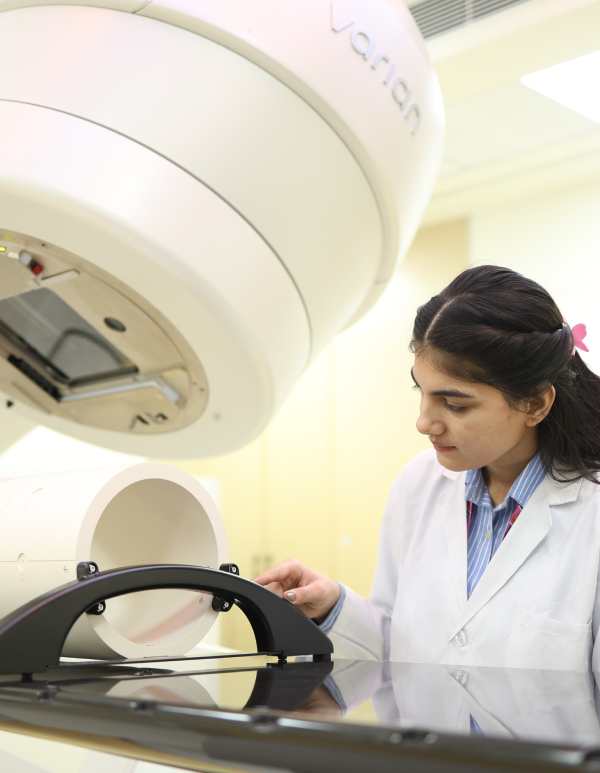
Career Paths

Phlebotomist

Clinical Microbiology Lab. Technologist

Medical/Clinical Lab. Technologist

Clinical Biochemistry Lab. Technologist

Blood Bank Technologist
Curriculum
| Course Category | Course Title |
|---|---|
| Core | Basic Anatomy (Including Histology) |
| Core | Physiology |
| Core | Biochemistry 1 |
| Core (Practical) | Biochemistry 1 Lab |
| Core | Pathology 1 |
| Core (Practical) | Pathology 1 Lab |
| Core | Microbiology 1 |
| Core (Practical) | Microbiology1 Lab |
| Subsidiary | English |
| Subsidiary | Biostatistics |
| Course Category | Course Title |
|---|---|
| Core | Biochemistry 2 |
| Core (Practical) | Biochemistry 2 Lab |
| Core | Microbiology 2 |
| Core (Practical) | Microbiology 2 Lab |
| Core | Pathology 2 |
| Core (Practical) | Pathology 2 Lab |
| Subsidiary | Environmental Science &Health |
| Subsidiary | Health care |
| VAC | Bioethics |
| Course Category | Course Title |
|---|---|
| Core | Biochemistry 3 |
| Core | Biochemistry 3 Lab |
| Core | Microbiology 3 |
| Core | Microbiology3 Lab |
| Core | Pathology 3 |
| Core | Pathology 3 Lab |
| Subsidiary | Computer application* |
| VAC | Global Health Diplomacy* |
Tuition Fee
₹81500
Note
*Lab & Library fee will be charged separately
#Program Proposed from Session 2026-27

Apply for admissions at Jaipur National University
APPLY ONLINE 1800-102-1900
  admissions@jnujaipur.ac.in
 Engage, Connect and Experience
the vibrant Life at JNU
Acres Green
Campus
State-of-the-Art
Labs
Smart
Classrooms
Signature Annual
Events
Student
Clubs

Enriching the
Intellect


Inspire Your
Essence


Explore Other Programs

-

Bachelor of Nutrition and Dietetics (Honors)
-
Bachelor’s in Medical Radiology and Imaging Technology (BMRIT)
-
Bachelor’s in Anaesthesia & Operation Theatre Technology (B. AOTT)
-
Bachelor in Cardiovascular Technology / Cath Lab Technology
-
Bachelor of Optometry (B. Optom)
-
B.Sc. (Hons.) Forensic science
-
Bachelor of Physiotherapy
Frequently Asked Questions
The B.Sc MLT programmme enriches the students with knowledge about diagnostic part of medical science
(i.e. Detections of the infections, diseases & disorders)
that help the doctors in treatment of the diseases. Students of this programme study the backbone courses (like medical microbiology, medical biochemistry and different aspects of pathology etc.) of medical sciences which enable them to know about the causes, mechanism of development and methods of testing/finding the causes and types of the diseases. Unlike doctors and nurses who interact directly with patients, this programme provides an in-demand opportunities in the field of healthcare where Medical Lab Technologists work without direct contact with patients but still having a positive impact on patient’s health.The students who successfully complete the B.Sc MLT programmme are designated as Medical Lab. Technologist.
Future Scope:
Day by day increase in frequency of infected people, emergence of the new diseases and challenges in their treatment has accelerated the demand of the Medical Lab. Technologist who finds out the cause and type of the disease so the they can be cured. According to Bureau of Labor Statistics the (BLS), there will be "14 percent projected increase in employment for Medical Lab Technologists through 2026 which is the twice of the projected national average for all occupations" (Bureau of Labor Statistics, U.S. Department of Labor, Occupational Outlook Handbook, [career information accessed May 21, 2018]. www.bls.gov/ooh/).
Medical Lab. Technologists are a critical professional part of the functioning of the hospitals and healthcare organizations. They work in coordination with physicians, nurses to perform tests on the specimens/samples of the patients to detect the infection, diseases or illness. On the basis of report of the tests performed by Lab.
They perform the detection diseases on the patient's sample using the all possible safety measure (a full lab coat, mask, gloves and goggles) in an isolated area where no patients, their attendants or any other professional are allowed to enter to ensure the safety of Lab. Technologists and prevention of the spread of diseases.
Apart from diagnostic jobs, they actively engage themselves in biomedical industries as QA QC officers, researches in the biomedical fields and academics job in collages and institution.
Medical lab technologists also perform the following jobs:
- Collecting blood, body fluids, tissue or other samples from patients.
- Matching blood compatibility for transfusions, organs compatibility for organ transplantation, analyze the chemical content of body fluids, blood to detect disorders and diseases.
- Detect parasitic, bacterial, fungal & viral infection in samples of patients.
- Perform tests which help in in-vitro fertilization (IVF).
- Setting up, maintaining, calibrating, cleaning and testing the sterility of lab equipment.
- Preparing solutions or reagents to be combined with samples.
The potential specialties are:
- Medical Microbiology
- Clinical Biochemistry
- Blood Banking and Transfusion Medicine
- Hematology and Immunohematology
- Histo and Cytopathology
- Diagnostic Cytogenetics
- In-vitro fertilization (IVF)
- Diagnostic Molecular Biology
The different areas where lab. technologist can have high profile jobs are:
- Government Hospitals (like AIIMS, Chandigarh PGI, RML, GTB, Safdarjung, SMS Lady Harding, Sir Gangaram hospitals and other hospitals all over the India).
- Private/Corporate Hospitals (like Forties, Max, Apolo, Narayana hospital etc)
- Railway's & Army's, & ISRO's Hospital etc.
- Diagnostic/Pathology Lab (Dr. Lal Path etc)
- Nursing homes
- Biomedical Industries like (Dr. Reddy, Acon, Thyrocare)
- Healthcare projects (Govt. & NGO funded)
- Forensic Science
Medical Lab Technologists can setup their own Pathology/Diagnostic Lab.
Pass with 50% aggregate marks in 10+2 (with PCB).
A. As a B. Sc. MLT degree holder, you have
-
Go for Higher Studies:
- M. Sc. in Medical Lab Technology, Medical microbiology/ Biochemistry/Forensic science/ Embryology/ and many other stream. (You can choose Medical microbiology in JNU, Jaipur).
- Go for an MBA (in hospital administration) and enter the world of Business Development, Marketing & Sales. (You can choose B.Sc MLT with MBA in JNU, Jaipur).
- For Abroad: IELTS/GRE/TOEFL.
B. USPs of B.Sc. MLT programme of JNU, Jaipur
- Our B.Sc MLT program enriches the theoretical knowledge of classrooms with practical skill development through lab practice, conferences and project work etc.
- This programme at JNU run with regular hospital training in the 1000 bedded JNU hospital along with theoretical classes.
- Our teaching-learning process provides students (both weak and sharp) equal opportunity to plan, access and improve his academic theoretical and practical skills.
- Our curriculum offers multidisciplinary specialization with emerging areas such as molecular diagnostic techniques, medical biochemistry, medical microbiology and cytogenetics etc.
- Students are encouraged to attend various workshops and conferences to equip them about the latest research related to industry-academia collaboration.
- Students are inspired for innovation and entrepreneurial thinking aligned to societal needs and scientific advancements through regular discussions and seminars.
- Our pedagogy encourages imbibing practical skills that can be honed through project- based learning and by studying real-world case scenarios.
- Clinical experts from various fields of medical sciences are invited regularly to interact with students.
- Students are taught the basic requisite for writing research proposals and are thus encouraged to participate in various national and international short term- training programmes.
- Regular assignments are assigned to students in the form of poster presentation, constructing a working model or power point presentation on latest research topics.
- The course curriculum is regularly updated and evaluated with emphasis on cutting edges technology and there practical and industrial application.
- Highly educated faculty with strong alignment for research and development. All of the faculties are Ph.D. holders.
Collaborations: JNU hospital, Jaipur
Typically, students must have completed their 10+2 (or equivalent) with a science background, including subjects like Physics, Chemistry, and Biology.
The program usually lasts three years, often followed by an additional six months to one year of internship or clinical training.
The course includes subjects such as Clinical Biochemistry, Hematology, Microbiology, Immunology, Pathology, and Medical Ethics, with practical training in laboratory techniques.
Graduates can work as lab technicians, medical laboratory technologists, lab managers, or pathology technicians in hospitals, diagnostic labs, research labs, and blood banks.
Yes, practical training is essential. Students gain hands-on experience with lab equipment, specimen analysis, and diagnostic procedures through internships and supervised lab work.
Yes the course in approved by Rajasthan State Allied and Healthcare Council.


Copyright © 2026 Jaipur National University. All Rights Reserved.
Website Design and Development by Sterco Digitex


Browse by School
- School of Engineering & Technology
- School of Business & Management
- School of Computer & Systems Sciences
- School of Education
- School of Languages, Literature and Society
- School of Life & Basic Sciences
- School of Pharmaceutical Sciences
- School of Media Studies
- School of Fashion Design
- Seedling School of Law and Governance
- Seedling School of Nursing
- Seedling School of Allied and Healthcare Sciences
- School of Agricultural Sciences
- School of Hotel Management & Catering Technology
- Jaipur National University Institute for Medical Sciences and Research Centre