


- About Us
About the University
Jaipur National University, Jaipur is one of the top self-financed private university in Rajasthan sponsored by the Mahima Shiksha Samiti.

Innovation and Incubation
If you have an innovative idea, we can show you the way ahead. Be an entrepreneur with the perfect..
Social Impact/CSR
Social responsibility takes many forms - from providing affordable/free healthcare...
Why JNU?
Their focus is to develop both education and critical skills to help our students excel in life.
- Admissions
- Academics
Schools
- School of Engineering & Technology
- School of Business & Management
- School of Computer & Systems Sciences
- School of Education
- School of Languages, Literature and Society
- School of Life & Basic Sciences
- School of Pharmaceutical Sciences
- School of Media Studies
- School of Fashion Design
- Seedling School of Law and Governance
- Seedling School of Nursing
- Seedling School of Allied and Healthcare Sciences
- School of Agricultural Sciences
- School of Hotel Management & Catering Technology
- Jaipur National University Institute for Medical Sciences and Research Centre
- Research
- Campus Life
Enriching the Intellect

Inspire Your Essence
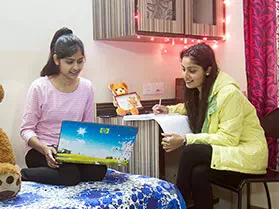
Outside the classroom

Adapt to Physical Wellness

-

 Admission HelpDesk



-
Duration
2 Years
-
Eligibility
Graduation in any stream of Basic Science
with Physics and Mathematics with min. 50%
-
Selection Procedure
Merit + PI
Program Outcomes
Core Knowledge and Applications
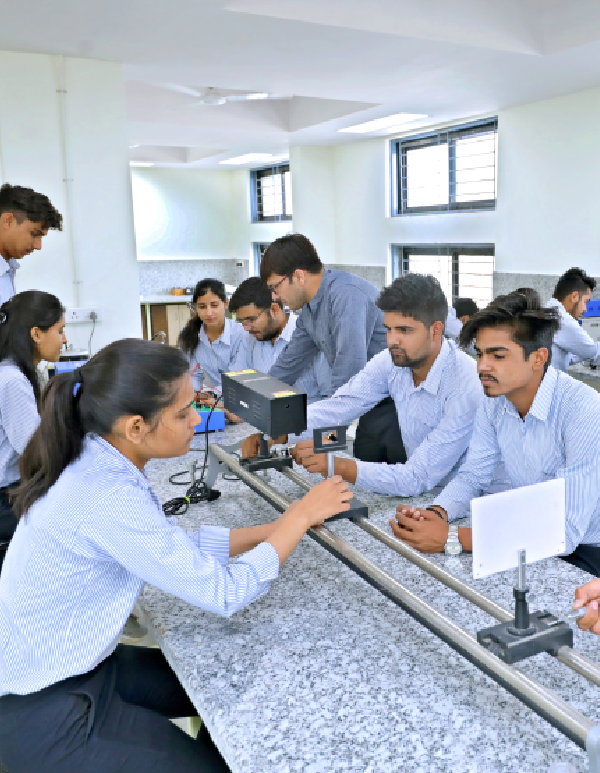
Understand the fundamentals and advancements in key areas of physics (Classical Mechanics, Electrodynamics, Nuclear Physics, Quantum Physics, etc.) and apply this knowledge in fields like nuclear reactors, accelerators, and medical physics.
Mathematical and Computational Skills
Apply mathematical modeling, computational techniques, and mathematical methods to solve complex problems in physics.
Materials Science and Characterization
Understand the electromagnetic properties of materials, advanced characterization techniques, and recent developments in materials science.
Research and Problem Formulation
Develop the ability to formulate and approach research problems in both theoretical and experimental physics, with strong problem-solving and research skills.
Career Paths

Industry/Academic Researcher

Lecturer/Professor

Scientific Consultant

Data Scientist/Analyst

Medical Physicist

Software Developer/Engineer
Nuclear Physicist
Quantum Computing Specialist
Materials Scientist
Patent Examiner/Intellectual Property Consultant
Curriculum
| Course Category | Subject Name | Credits |
|---|---|---|
| Core | Mathematical Physics | 4 |
| Core | Classical Mechanics | 4 |
| Core | Quantum Mechanics | 4 |
| Practical I | General Physics Laboratory | 3 |
| Practical II | Electronics Laboratory-I | 3 |
| DSE Discipline Specific Elective | Solid State Electronics | 3 |
| Radiation Physics | ||
| SECSkill Enhancement Course | Basics of Computation/ Personality Development | 2 |
| EC** | Extracurricular | |
| Total Credits | 23 | |
| Course Category | Subject Name | Credits |
|---|---|---|
| Core | Condensed Matter Physics | 4 |
| Core | Advanced Quantum Mechanics | 4 |
| Core | Computational Physics | 4 |
| Practical 1 | Computational Physics Lab. | 3 |
| Practical 2 | Electronics Laboratory-II | 3 |
| DSE Discipline Specific Elective | Synthesis, Characterization and Applications of Nanomaterials | 3 |
| Analog and Digital Communications | ||
| SEC Skill Enhancement Course | Hands on Mathematical Tools/ Learning Skills and Entrepreneurship | 2 |
| EC** | Extracurricular | |
| Total Credits | 23 | |
| Course Category | Subject Name | Credits |
|---|---|---|
| Core | Nuclear and Particle Physics | 4 |
| Core | Electrodynamics and Plasma Physics | 4 |
| Core | Atomic and Molecular Physics | 4 |
| Core | Microwave Devices and Communications | 4 |
| Practical 1 | Microwave and Communication Lab | 3 |
| DSE Discipline Specific Elective | Laser Optics and Spectroscopy | 3 |
| Low Temperature Physics | ||
| VAC Value Added Course | Research Integrity and Scientific Writing / Indian Knowledge System | 2 |
| CC | Co-curricular | |
| Total Credits | 22 | |
| Course Category | Subject Name | Credits |
|---|---|---|
| Core | Thermodynamics and Statistical Physics | 4 |
| Core | Research Project | 9 |
| DSE Discipline Specific Elective | Atmospheric and Space Physics | 3 |
| Science of Renewable Energy Sources | ||
| Total Credits | 16 | |
Tuition Fee
₹35900
Note
*Lab & Library fee will be charged separately
#Program Proposed from Session 2026-27

Apply for admissions at Jaipur National University
APPLY ONLINE 1800-102-1900
  admissions@jnujaipur.ac.in
 Internship Opportunities


Engage, Connect and Experience
the vibrant Life at JNU
Acres Green
Campus
State-of-the-Art
Labs
Smart
Classrooms
Signature Annual
Events
Student
Clubs

Enriching the
Intellect


Inspire Your
Essence


Frequently Asked Questions
It is a postgraduate program that can be taken after graduating course. M.Sc. is a master’s degree which provides the theoretical as well as practical knowledge in science. This is offered by many universities in India. Some of these universities also offer interdisciplinary M.Sc. courses.
After getting a M.Sc. degree, candidates may apply for a PhD course or in research institutes such as ISRO, DRDO, BARC, TIFR, NPL etc. who conducts exam for the Scientist posts. Beyond this there many jobs in Indian military such as in Indian air force, Navy and Army. A student can chart his career in higher education after qualify NET, SLET examinations which are based on M.Sc. qualification.
No. A student should have a Bachelors degree with Physics and Mathematics at graduation level.
The Master of Science degree is popularly abbreviated to MS in the US and M.Sc. in the India, UK and certain Commonwealth countries. MS is a professional course than the M.Sc. course. It is perceived to be a better program when compared to the M.Sc. program. Those who have completed M.Sc. or Bachelor in Engineering can also do the MS program.
Yes, you can do M.Sc. Physics after completing your B.Sc. in Mathematics, but you need to some elective subjects of physics. If you fulfill the criteria of post-graduation entrance exam, then you can do it.
Yes, According to University norms.
The department has a well-qualified, experienced teaching staff. There is one Professor, two Associate Professor and few faculty members from interdisciplinary area. They are also actively involved in research and have published articles extensively in different areas of Physics.
- Use of ICT in teaching learning process
- Introduction of minor and major projects in the curriculam.
- Co- curricular activities to bridge the gaps in curriculum.
- Breadth of electives offered.
- Identification of weak and advanced learners.
Presently no, any specialization although electives are offered in last semester.
As per University curriculum.
Yes we have strong network with alumni and conduct alumni Meets every year & also at the time of convocation.
Yes, class wise teacher are allotted as mentors for an overall coordination to resolve the various issues of our students.
It is a postgraduate program that can be taken after graduating course. M.Sc. is a master’s degree which provides the theoretical as well as practical knowledge in science. This is offered by many universities in India. Some of these universities also offer interdisciplinary M.Sc. courses.
A Bachelor’s degree (B.Sc.) in Physics or a related subject with a 45 % of minimum percentage.
No, specialization is not always required during a M.Sc. Physics course, but many universities offer specializations in areas such as astrophysics, quantum mechanics, nuclear physics, or materials science. Specializing can give you an edge if you are aiming for a career or further study in a specific field.
No. A student should have Bachelor degree with Physics and Mathematics at graduation level.
Yes, you can do M.Sc. Physics after completing your B.Sc. in Mathematics, but you need to some elective subjects of physics. If you fulfill the criteria of post-graduation entrance exam, then you can do it.


Copyright © 2026 Jaipur National University. All Rights Reserved.
Website Design and Development by Sterco Digitex


Browse by School
- School of Engineering & Technology
- School of Business & Management
- School of Computer & Systems Sciences
- School of Education
- School of Languages, Literature and Society
- School of Life & Basic Sciences
- School of Pharmaceutical Sciences
- School of Media Studies
- School of Fashion Design
- Seedling School of Law and Governance
- Seedling School of Nursing
- Seedling School of Allied and Healthcare Sciences
- School of Agricultural Sciences
- School of Hotel Management & Catering Technology
- Jaipur National University Institute for Medical Sciences and Research Centre