


- About Us
About the University
Jaipur National University, Jaipur is one of the top self-financed private university in Rajasthan sponsored by the Mahima Shiksha Samiti.

Innovation and Incubation
If you have an innovative idea, we can show you the way ahead. Be an entrepreneur with the perfect..
Social Impact/CSR
Social responsibility takes many forms - from providing affordable/free healthcare...
Why JNU?
Their focus is to develop both education and critical skills to help our students excel in life.
- Admissions
- Academics
Schools
- School of Engineering & Technology
- School of Business & Management
- School of Computer & Systems Sciences
- School of Education
- School of Languages, Literature and Society
- School of Life & Basic Sciences
- School of Pharmaceutical Sciences
- School of Media Studies
- School of Fashion Design
- Seedling School of Law and Governance
- Seedling School of Nursing
- Seedling School of Allied and Healthcare Sciences
- School of Agricultural Sciences
- School of Hotel Management & Catering Technology
- Jaipur National University Institute for Medical Sciences and Research Centre
- Research
- Campus Life
Enriching the Intellect

Inspire Your Essence

Outside the classroom

Adapt to Physical Wellness

-

 Admission HelpDesk



-
Duration
2 Years
-
Eligibility
B.Sc. Pass/ Hons.
With Chemistry/ Biochemistry/ Biotechnology/ Microbiology/ Computer Science/ forensic Science or any equivalent degree
with min. of 50% marks
-
Selection Procedure
Merit + PI
Program Outcomes
Advanced Forensic Analysis
Demonstrate expertise in conducting complex forensic analyses of biological, chemical, and physical evidence.
Criminal Investigation Techniques
Apply scientific principles and forensic methods to investigate criminal cases.
Forensic Toxicologist
Identify and analyze toxic substances in biological samples, and assess their potential impact on health.
DNA Profiling and Serology
Perform DNA extraction, analysis, and profiling techniques and body fluid analysis, to support criminal investigations.
Cyber Forensics
Demonstrate the ability to investigate and analyze digital evidence from electronic devices and systems.
Legal and Ethical Aspects of Forensic Science
Apply knowledge of legal procedures, forensic law, and ethical considerations to forensic investigations
Forensic Psychology and Criminal Profiling
Integrate principles of psychology and criminology with forensic science.
Research and Innovation in Forensic Science
Conduct independent research in forensic science, contributing to the advancement of forensic techniques
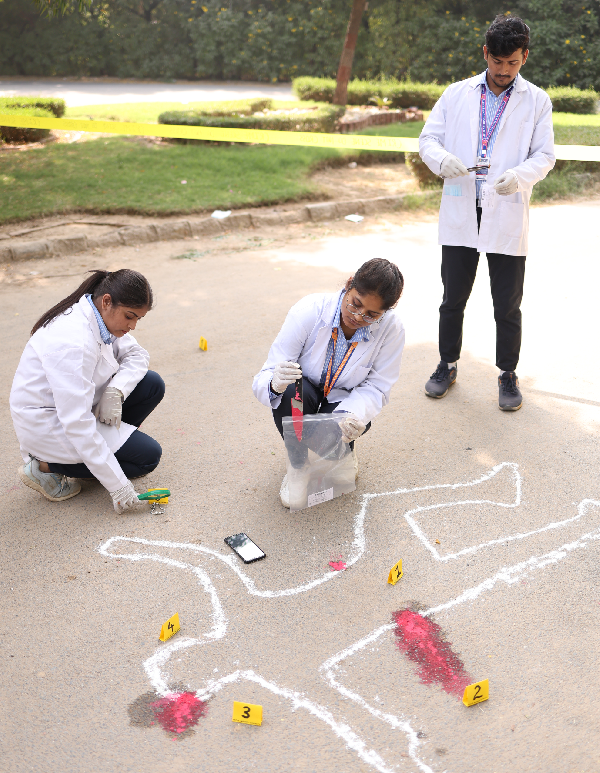
Career Paths

Forensic Scientist

Ballistics Expert

Senior Forensic Scientist

Forensic Research Scientist

DNA Analyst
Curriculum
| Course Category | Course Title | Credits |
|---|---|---|
| Core | General Forensic Science and Law | 4 |
| Core | Instrumental Techniques | 4 |
| Core | Criminalistics | 4 |
| Core | Questioned Documents and Fingerprints | 4 |
| Core | Forensic Biology and Anthropology | 4 |
| Practical | Practical-I | 2 |
| Practical | Practical - II | 2 |
| Total Credits | 24 | |
| Course Category | Course Title | Credits |
|---|---|---|
| Core | Research Methodology, Quality Management and Statistics | 4 |
| Core | Forensic Serology and DNA Typing | 4 |
| Core | Forensic Chemistry, Toxicology and NDPS | 4 |
| Core | Forensic Ballistics and Explosives | 4 |
| Core | Basic Concepts of Digital Forensics | 4 |
| Practical | Practical-I | 2 |
| Practical | Practical-II | 2 |
| Total Credits | 24 | |
Specialization (Forensic Chemistry and Toxicology)
| Course Category | Course Title | Credits |
|---|---|---|
| Core | Forensic Pharmacology and Pharmaceutical Drug analysis | 4 |
| Core | Advanced Forensic Toxicology | 4 |
| Core | Modern and Applied Analytical Chemistry | 4 |
| Core | Practical | 2 |
| Discipline Specific Elective | Students have to opt any one of the open elective courses offered By Institute/College/University | 3 |
| Co Curricular Activity (CC) | **Mandatory Qualifying Non Credit but graded course | |
| Total Credits | 17 | |
Specialization II (Forensic Physics and Ballistics)
| Course Category | Course Title | Credits |
|---|---|---|
| Core | Advances in Physical Techniques | 4 |
| Core | Advances in Forensic Ballistics and Armor Materials | 4 |
| Core | Audio Recognition and Video Analysis | 4 |
| Core | Practical | 2 |
| Discipline Specific Elective | Students have to opt any one of the open elective courses offered By Institute/College/University | 3 |
| Co curricular Activity (CC) | **Mandatory Qualifying Non Credit but graded course | |
| Total Credits | 17 | |
Specialization III (Cyber Forensics)
| Course Category | Course Title | Credits |
|---|---|---|
| Core | Cyber Law, Risk and Compliance | 4 |
| Core | Incident Response and Digital Forensics | 4 |
| Core | Vulnerability Assessment and Penetration Testing | 4 |
| Core | Practical | 2 |
| Discipline Specific Elective | Students have to opt any one of the open elective courses offered By Institute/College/University | 3 |
| Co curricular Activity (CC) | **Mandatory Qualifying Non Credit but graded course. | |
| Total Credits | 17 | |
Specialization IV (Forensic Biology and DNA)
| Course Category | Course Title | Credits |
|---|---|---|
| Core | Advance Forensic Biology | 4 |
| Core | Advance Forensic Serology and DNA Typing | 4 |
| Core | Molecular Biology and r-DNA Technology | 4 |
| Core | Practical | 2 |
| Discipline Specific Elective | Students have to opt any one of the open elective courses offered By Institute/College/University | 3 |
| Co curricular Activity (CC) | **Mandatory Qualifying Non Credit but graded course. | |
| Total Credits | 17 | |
Specialization V ( Crime Scene Management, Questioned Document and Fingerprints)
| Course Category | Course Title | Credits |
|---|---|---|
| Core | Advanced techniques in Crime Scene Management | 4 |
| Core | Modern Science in Fingerprint Technology | 4 |
| Core | Questioned Document and Forensic Accounting | 4 |
| Core | Practical | 2 |
| Discipline Specific Elective | Students have to opt any one of the open elective courses offered By Institute/College/University | 3 |
| Co curricular Activity (CC) | **Mandatory Qualifying Non Credit but graded course. | |
| Total Credits | 17 | |
| Subject Name | Credits |
|---|---|
| Dissertation/Major Project | 25 |
Tuition Fee
₹60000
Note
*Lab & Library fee will be charged separately
#Program Proposed from Session 2026-27

Apply for admissions at Jaipur National University
APPLY ONLINE 1800-102-1900
  admissions@jnujaipur.ac.in
 Internship Opportunities




Engage, Connect and Experience
the vibrant Life at JNU
Acres Green
Campus
State-of-the-Art
Labs
Smart
Classrooms
Signature Annual
Events
Student
Clubs

Enriching the
Intellect


Inspire Your
Essence




Frequently Asked Questions
B.Sc. Pass/ Hons. With Chemistry/Biochemistry/Biotechnology/ Microbiology/Computer Science/ forensic Science or any equivalent degree with min. of 50% marks
To become a good Forensic Scientist, Crime Scene Investigator, Forensic Anthropologist etc.
Graduates may pursue roles as forensic scientists, crime scene investigators, forensic analysts, or experts in specialized forensic fields. Additionally, the skills acquired during the program can be valuable in contributing to the justice system and aiding in the resolution of criminal cases.
Crime Scene Investigator
- Digital Forensic Analyst
- Forensic Psychologist
- Forensic Anthropologist
- Forensic toxicologist
- Forensic DNA expert
- Forensic Questioned Document Expert
- Forensic Fingerprint Expert
For pursuing M.Sc. in Forensic Science, a bachelor's degree in science (e.g., B.Sc. in Biology, Chemistry, Physics, Biotechnology, Microbiology, Forensic Science or related fields) is mandatory.
Common topics include Forensic Biology, Forensic Chemistry, Forensic Toxicology, Criminal Law, Forensic Psychology, Digital Forensics, Forensic Anthropology, DNA Profiling, Crime Scene Investigation, and Instrumental Analysis.
Graduates can work in government forensic labs, private forensic consultancies, police departments, law enforcement agencies, research institutions, and educational institutions. Roles include forensic analyst, crime scene investigator, toxicologist, forensic psychologist, and DNA analyst, among others.
Yes, students can pursue a Ph.D. in Forensic Science or related fields. There are also opportunities for research roles in forensic labs, academic institutions, and independent research organizations.
Forensic Science focuses on the scientific analysis of evidence to support investigations, while Criminology studies criminal behavior, motives, and societal impact. Forensic Science is more lab-based, whereas Criminology has a broader sociological focus.
Not necessarily. While a background in Forensic Science can be advantageous, most programs accept students with a general science background, such as biology, chemistry, or physics.


Copyright © 2026 Jaipur National University. All Rights Reserved.
Website Design and Development by Sterco Digitex


Browse by School
- School of Engineering & Technology
- School of Business & Management
- School of Computer & Systems Sciences
- School of Education
- School of Languages, Literature and Society
- School of Life & Basic Sciences
- School of Pharmaceutical Sciences
- School of Media Studies
- School of Fashion Design
- Seedling School of Law and Governance
- Seedling School of Nursing
- Seedling School of Allied and Healthcare Sciences
- School of Agricultural Sciences
- School of Hotel Management & Catering Technology
- Jaipur National University Institute for Medical Sciences and Research Centre