



 Admission HelpDesk






About IMSRC
The Medical College at JNU is dedicated to delivering world-class education, research and other scholarly activities that benefit patients and society, healthcare practice and practitioners, and the healthcare education community significantly. The College provides acknowledged educational programs that span the breadth and depth of the knowledge necessary to train the next generation of medical practitioners.
World-class laboratories equipped with advanced equipment, animal simulations, a skill development lab and a vast patient pool make it an excellent example of “learning by doing”. Students are encouraged to inquire and explore new techniques for better understanding, diagnosis & treatment of serious ailments. Faculty members are highly engaged and passionate about research, teaching and mentoring students.
The Medical College is committed to maintaining high academic standards and continuously enhancing the quality of learning and teaching. The College building houses the eight pre- and para-clinical departments: Anatomy, Physiology, Biochemistry, Pathology, Microbiology, Pharmacology, Forensic Medicine and Community Medicine. All departments are well equipped and have separate research labs. Lecture theatres are air-conditioned and furnished with modern facilities and e-learning tools like Wi-Fi, LCD projectors and microphones. Along with departmental libraries, there is a well-stocked Central Library with more than 11,000 books, national and international journals, a computer lab with internet facility and computer simulation programmes for undergraduate teaching.
Stakeholders are committed to supporting a vibrant intellectual environment, with the ultimate goal of translating ground-breaking discoveries into medical therapies that will eradicate disease and improve healthcare locally and beyond. We coordinate efforts within the University framework to optimise the development and meaningful engagement of healthcare professionals, ensuring our endeavours remain mindful of evolving contexts and demands.
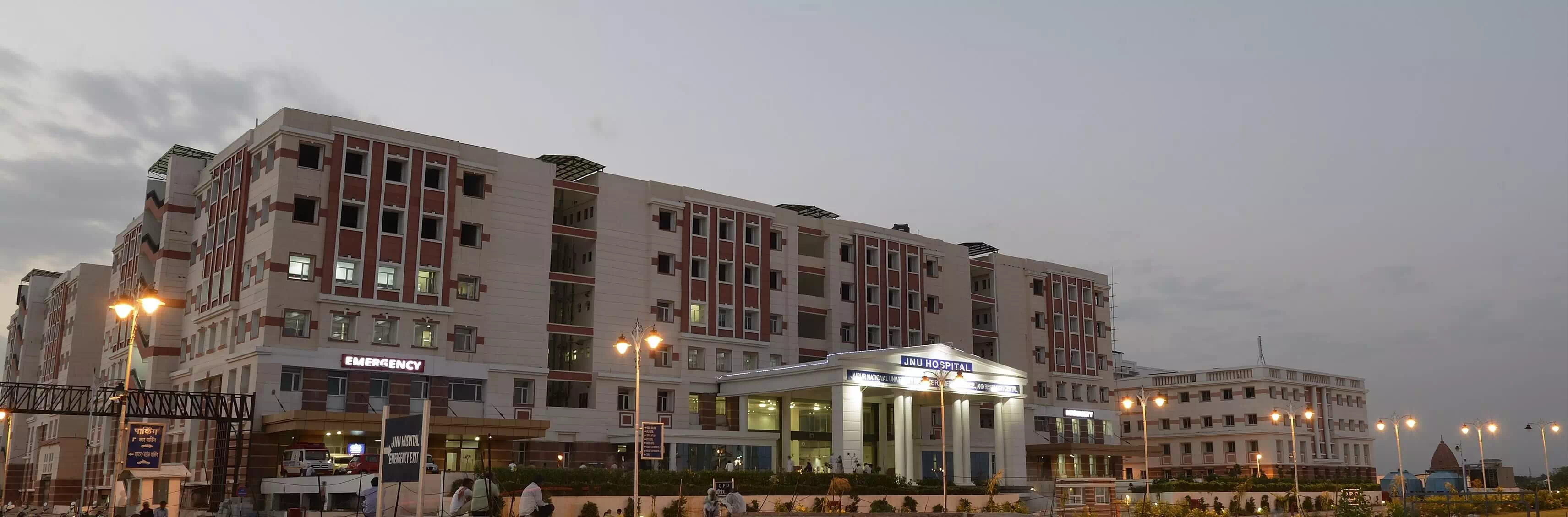
Located amidst salubrious green surroundings, the JNU Hospital boasts world-class infrastructure, a friendly environment, cutting-edge technology, highly experienced and qualified doctors, and skilled paramedical staff who work with the motto "care with compassion".
The Hospital is committed to building on the core principles of quality, safety and clinical excellence while bringing cost-effective healthcare to people across India. At JNU IMSRC we make every effort to ensure the healthcare system and those working within it follow exemplary ethics and act in the best interest of patients.
There are multispecialty departments of General Medicine, General Surgery, Obstetrics & Gynecology and Pediatrics, and allied departments such as Dermatology, Psychiatry, Respiratory Medicine, Orthopedics, ENT, Ophthalmology and Anesthesia. We have modern critical care units, an advanced cardiac cath lab and a cancer care unit. The current capacity is 810 beds, planned to increase to 1,100 beds. Other services include Casualty & Emergency services, 24×7 central labs, a blood bank, and radiology equipped with digital X-ray, ultrasonography, multi-slice CT scanners and MRI.
To fulfil our commitment to continuing education for faculty, staff, physicians and students, the hospital has hosted events such as the International 3D NeuroAnatomy Workshop, Advanced Laparoscopic & Bariatric Surgery programmes, First Responder Training, endoscopic workshops on microanatomy, pain education workshops and more.
Committed to a legacy of excellence in healthcare, JNU Medical College & Hospital Jaipur strives to be a leader in medicine. We endeavour, through education, training and research, to prepare compassionate, professionally competent and ethically sound clinicians who will provide promotive, preventive and curative healthcare services of the highest standard, with special concern for the differently abled, disadvantaged and underserved.
- JNUIMSRC is committed to maintaining high academic standards and continuously enhancing the quality of learning and teaching, fostering inquiry and intellectual curiosity, and equipping students with skills for lifelong learning. We focus on learner-centric education using both traditional and modern methods.
- Salient features of Quality Academics:
- Regular academic counselling of students
- Regular faculty development programmes
- Digital library
- Guest lectures by renowned academicians
- Regular workshops & seminars
- Periodic curriculum updates
- Student awards (Gold medals):
- Shri M.S. Bakshi Gold Medal — Topper in 1st Prof, 2nd Prof, 3rd Prof & Final Prof MBBS University Examinations
- Topper in Anatomy, Physiology & Biochemistry in 1st Prof MBBS
- Topper in Pathology, Pharmacology, Microbiology & Forensic Medicine in 2nd Prof MBBS
- Topper in ENT, Ophthalmology & Community Medicine in 3rd Prof MBBS
- Topper in Medicine, Surgery, Obstetrics & Gynecology & Pediatrics in Final Prof MBBS
Core Values Driving Us at JNUIMSRC
JNUIMSRC is dedicated to achieving excellence and exemplary leadership in medicine through dissemination of high quality education, ground breaking research and exceptional clinical care.
The Values That Continue to Guide Us Include
Collaboration & Service
- We promote work, collaboration and synergy at all levels to serve our local, regional and state communities and to enhance the overall University environment.
- We acknowledge that our conduct impacts the experiences of others and acts in ways that uphold human dignity and self respect
- We serve all people, especially the destitute and the vulnerable.
Diversity & Respect
- We value and respect all individuals for their individual perspectives, experiences and potential to learn and serve.
- We foster a safe environment wherein all feel engaged and included.
- We respect the cultural diversity among faculty, staff and students and ensure a respectful and ethical academic environment.
Integrity & Accountability
- We adhere to ethical conduct in all our dealings
- We lead in a responsible and accountable way and share constructive feedback with all stakeholders
Quest For Learning
- We promote an environment of continuous and consistent learning and discovery to positively impact the student experience at the Institute.
- We embrace innovation and risk taking as inevitable stepping stones leading to outstanding evidence-based health care, rigorous research and elevated teaching.
- We aim for outstanding results through well planned and consistent professional and personal improvement.
Wellness & Balance
- We value, uphold and enhance the well-being of every member of the community.
- We encourage and support healthy and dynamic lifestyles through our varied pursuits.
Chancellor's Address
"[Being a doctor] offers the most complete and constant union of those three qualities which have the greatest charm for pure and active minds – novelty, utility, and charity." - Sir James Paget

We have an innate desire to touch others deeply and have a positive impact on their lives. If you’re passionate about science, healthcare and helping people, and you find the human body fascinating, you cannot go wrong with studying and working in Medicine & Health. That focus characterizes everything we do, from admissions to curriculum design, to teaching and mentoring, to our clinical practice. Welcome to Jaipur National University Institute of Medical Sciences and Research Centre! There can be no denying that medical education is undergoing a substantial transformation and our institution strives to position itself at the forefront of these challenges by offering an innovative curriculum, thereby addressing the academic and professional requirements of physicians for future medical practice.
We are constantly on the move to promote wholeness, wellness and a sense of connection with the world and to each other, so that our students can lead better lives as professionals. Beyond the campus, we share the University’s commitment to civic engagement and to serving our local and global communities.
We provide avenues for our students to develop new interests, or continue established pursuits – in civic activities, music and other arts.
Given the right opportunity to grow as individuals by meeting new challenges in an environment of collaborative learning and respect, students at the medical school discover a deep sense of purpose and emerge sure of their knowledge and skills, with a healthy perspective and a measure of humility appropriate to lifelong learners.
What most distinguishes us as an institute is the people who associate with us: a cadre of collaborative research and clinical mentors, medical practitioners, and a cohesive group of driven and dynamic students. Our commitment to mentoring and career development, together with this supportive community of scholars, fosters great interest and involvement in the art and practice of medicine and enhances career success.
JNUIMSRC continues with sustained effort, enthusiasm, sincerity, and motivation to address the needs of current and future medical practice through its undergraduate and post graduate programs. We invite you to join us, as we move forward on this exciting journey of student-centered medical education for patient-centered health care. This is an excellent time to prepare for a career in medicine considering the advances in curriculum design, learning theories, and technologically assisted information acquisition, evidence-based practice, analysis, and dissemination of information.
Studying Medicine is a long-term commitment and a decision that shouldn’t be taken lightly. There’s nothing better than seeing people joyful and healthy. Knowing that you play a big role in restoring their health and relieving their pain is perhaps the strongest and most important reason why so many people choose to study and work in Medicine. As Daniel Ofri has rightly said-
"The awe of discovering the human body. The honor of being trusted to give advice. The gratitude for helping someone through a difficult illness. These things never grow old."
WELCOME TO THE WORLD OF MEDICINE.
WELCOME TO JNUIMSRC.
I wish you greatness.
Dr.Sandeep Bakshi
[Chancellor]
Infrastructure

The medical college has world class academic and infrastructural facilities.

There are four lecture theatres in the college with a seating capacity of 300 students each and one extra lecture theatre in the hospital with a seating capacity of 281 students. The lecture theatres are gallery type and equipped with audiovisual aids, smart board, computer and Wi‑Fi. Each department is well equipped with demonstration rooms, museum, library and research lab.

A central library which is fully air conditioned and well stocked with 16,117 books and has 244 national and international journals. There are air conditioned external and internal reading rooms for UG students, a PG student reading room, a reading room for faculty, staffrooms, a book store room and a computer lab. The library is provided with Wi‑Fi connectivity and computers for online access to books and journals.
There are two examination halls which are fully air conditioned and equipped with audio visual aids and have a seating capacity of 300 students each.


JNU IMSRC has well maintained and modern cafeteria and mess facilities for the students. These cafeterias also serve as gathering places for students to socialise and discuss academic work. One can get freshly made gourmet sandwiches, hot coffee, noodles, or a sweet treat at any of the campus cafes.

Giving top priority to the health of the students, the university has set up well equipped gymnasiums on campus. The latest machines ensure better fitness and health facilities for students as well as faculty. Common equipment includes Swiss balls, treadmills, dumbbells, smith machines, cross trainers, benches and steppers.

To create a home away from home, JNU has carefully designed comfortable hostel rooms. Hostels provide the best amenities so students can focus on curricular and extracurricular activities. Rooms are spacious and acoustically treated to reduce external noise. Discipline, safety and security are priorities: 24‑hour security and a resident warden are assigned to every hostel.
Each student is provided with essential furniture including a chair, table, bed and full‑size cupboard. Each hostel has a visitor room, a study room with computer and internet facilities, and is air‑conditioned. Recreational rooms provide TV, music and indoor games; messing facilities are available on campus.
Facilities provided in the hostels are:
- Nutritious food
- Pure drinking water
- 24 hour security
- Doctor on call
- Telephone
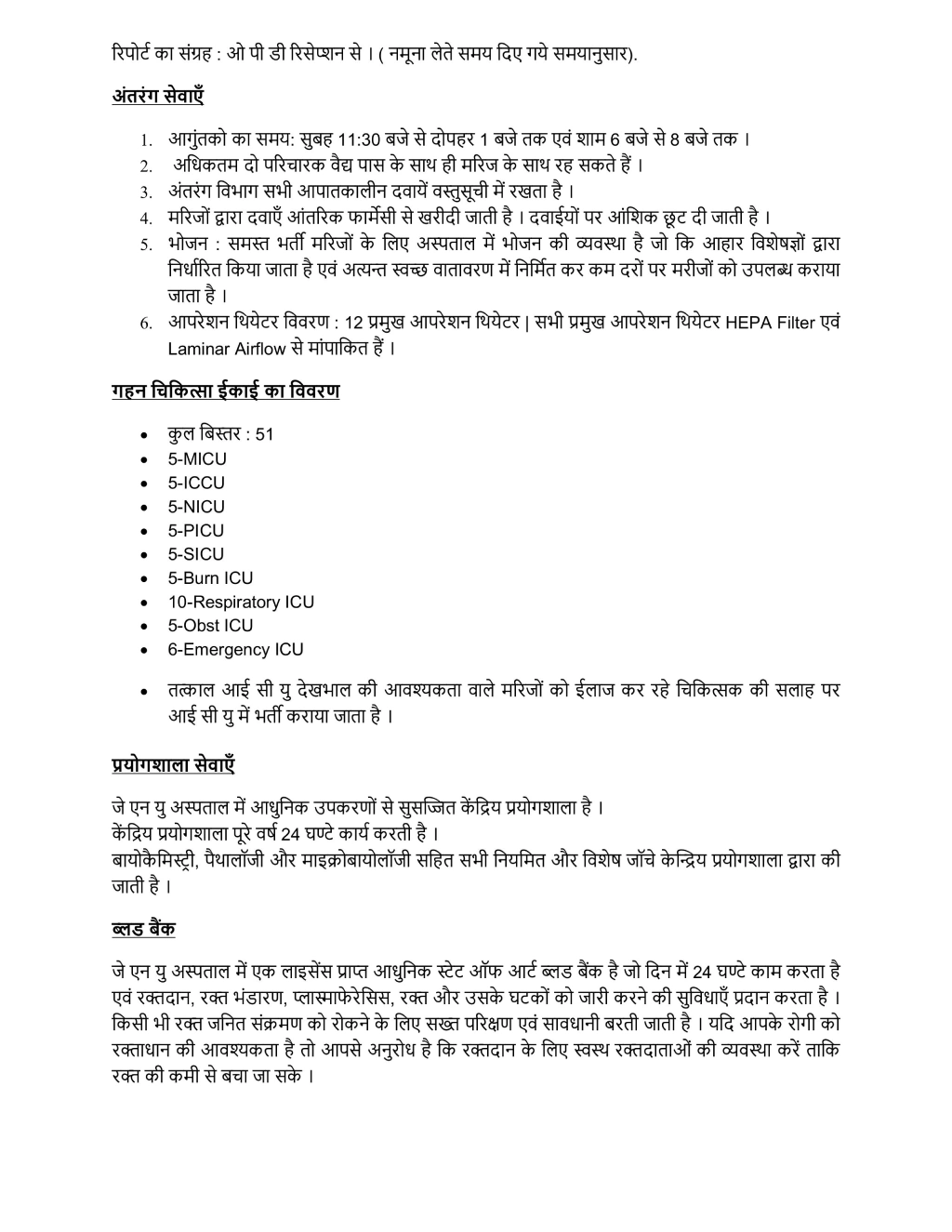
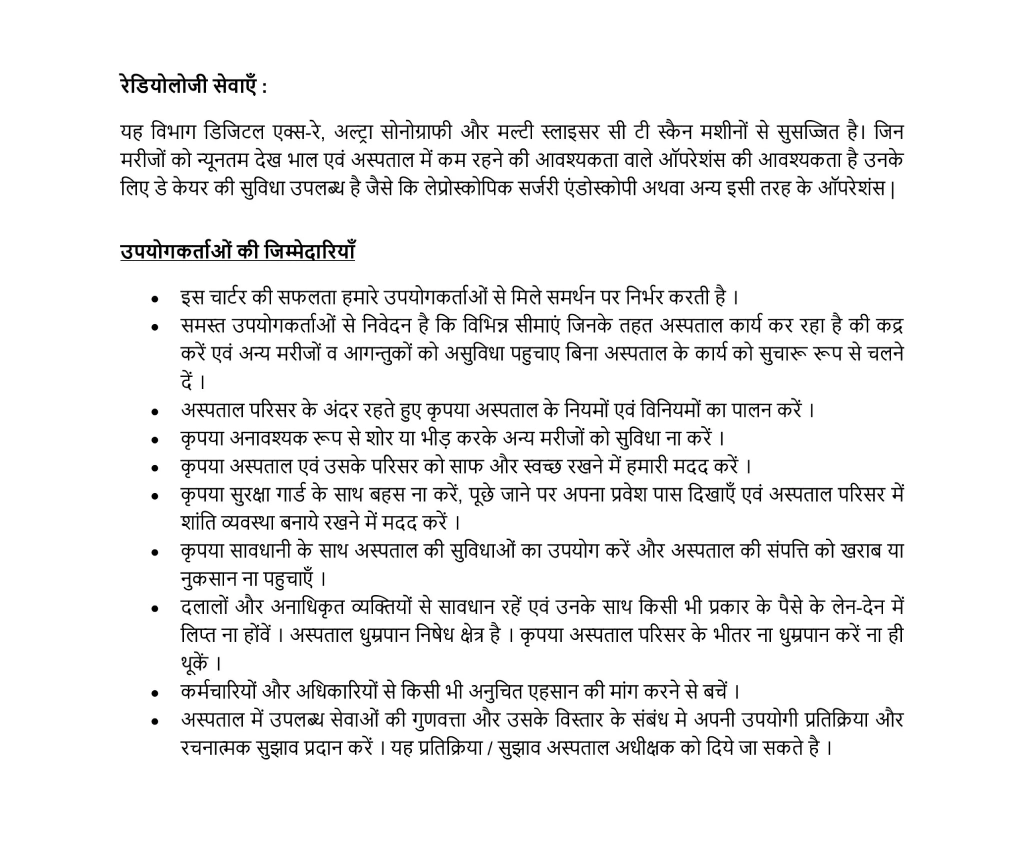
Citizen Charter (English)
Your Health, Our Priority
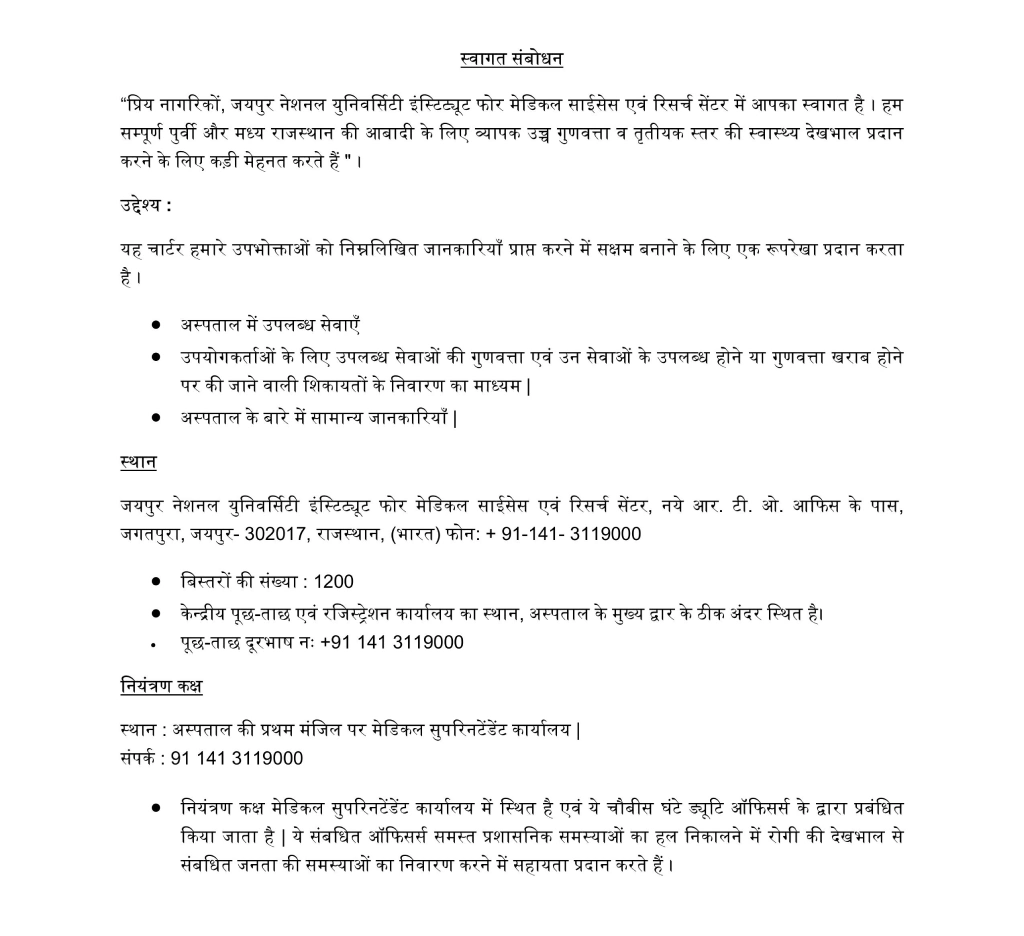
Dear Citizen, You are welcome to Jaipur National University Institute for Medical Sciences and Research Centre. We strive hard to provide comprehensive, high quality tertiary level health care to entire east and mid Rajasthan population.
Purpose
This charter seeks to provide a frame work, which enables our users to know:- The services available in this hospital, the quality of services they are entitled to and the means through which complaints regarding denial or poor quality of services will be redressed General information about the hospital.
Location: JNUIMSRC, Near New RTO office, Jagatpura, Jaipur
Total Number of Beds: 1200
Inquiry counter: At the front reception inside the entrance gate of the hospital
Contact No.: 0141-3119000
Functions round the clock in the Medical Superintendent's Office and is managed by Duty Officers, who deal with any administrative problem, provide assistance, and listen to public grievances with regard to patient care.
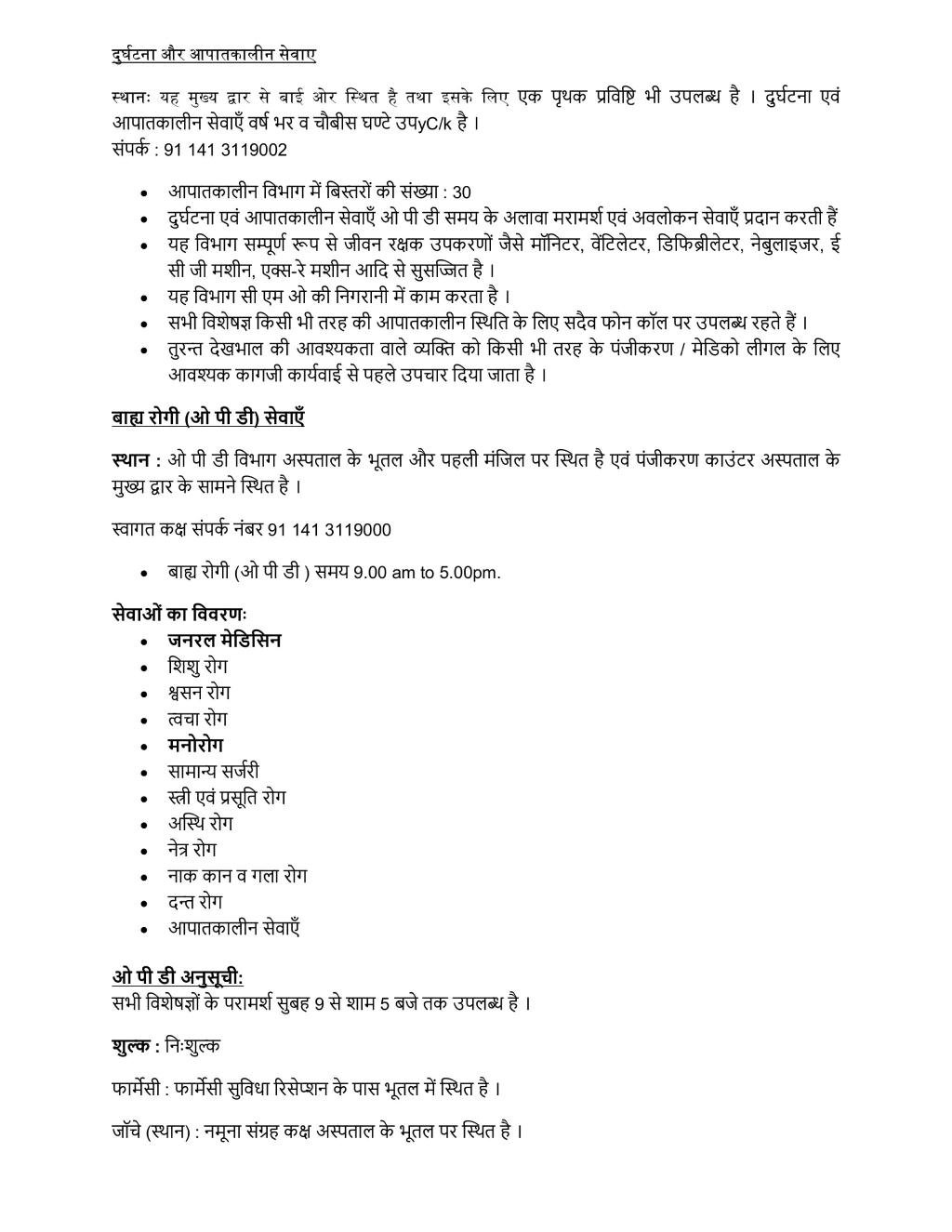
Location: On the left side from the main entrance; it also has a separate entry. Casualty & Emergency services function round the clock, throughout the year.
No. of beds in Emergency department: 30
Contact No.: 0141-3199002
Casualty & Emergency services provide consultation and observation services apart from OPD timings.
Casualty & Emergency services are fully equipped with all life-saving equipment like monitors, ventilators, defibrillators, nebulizers, ECG machines, X-ray machines, etc.
Casualty & Emergency services work under supervision of the CMO.
All specialists are available on a call basis to cater to all kinds of emergencies.
Persons requiring urgent care are treated before paperwork like registration or medico-legal requirements.
Location: OPD is situated on the ground and first floor of the hospital, and the registration counter is located in front of the main entrance of the hospital.
Reception Contact No.: 0141-3199000
OPD Timings: 9:00 am to 5:00 pm (All days except Sunday / Institutional Holidays)
Details of OPD Services:
- General Medicine
- Pediatrics
- T.B. & Chest
- Dermatology
- Psychiatry
- General Surgery
- Obst. & Gynecology
- Orthopedics
- Ophthalmology
- E.N.T.
- Dentistry
- Casualty (24×7)
OPD Schedule: Consultants from all specialities are available from 9:00 am to 5:00 pm.
Charges: Free
Pharmacy: In-house pharmacy is located on the ground floor near the reception.
Investigations Location: Sample collection room is located on the ground floor of the hospital.
Report Collection: From OPD Reception (Timings informed at the time of sample collection).
Visiting Time: 11:30 AM – 1:00 PM & 6:00 PM – 8:00 PM
Maximum 2 attendants (having valid passes) can stay with the patient.
Keeps all emergency medicines in inventory.
Medicines are purchased by the patient from the in-house pharmacy.
Food: In-house food is provided to all admitted patients as prescribed by the dietician and prepared under a strict hygienic environment at minimal rates.
(O.T.): 12 Major O.T.s — All are modular with HEPA filters and laminar flow. Minor O.T./Procedure rooms are present in all surgical departments and the Emergency Medicine Department.
ICU:
- Total Beds: 51
- MICU – 5
- ICCU – 5
- NICU – 5
- PICU – 5
- SICU – 5
- Respiratory ICU – 10
- Burn ICU – 5
- Obstetric ICU – 5
- Emergency ICU – 6
Patients requiring urgent ICU care are admitted to ICUs at the discretion of the treating doctors.
JNU IMSRC has a central lab equipped with modern equipment.
The central lab functions 24 hours a day throughout the year.
All routine and special investigations, including those related to Biochemistry, Pathology, and Microbiology, are conducted by the central lab.
JNU IMSRC has a licensed modern, state of the art Blood Centre that functions 24 hours a day and provides facilities for blood donation, storage, issue of blood and its components. Strict precautions are taken and testing is done to prevent any blood borne infection. If your patient requires blood transfusions, then you are requested to arrange healthy blood donors for donating blood in order to reduce shortage of blood.
Department is equipped with digital X-Ray, Ultra sonography and 386 slice CT scan machine and MRI.
Day care facility is available for certain types of operations requiring minimal access and less hospital stay.
- The success of this charter depends on the support we receive from our users.
- Appreciate the various limitations under which the hospital is functioning and ensure its smooth working without inconveniencing other patients and visitors.
- Please follow the rules and regulations of the hospital while inside the hospital campus.
- Please do not cause inconvenience to other patients by crowding or making noise unnecessarily.
- Please help us in keeping the hospital and its surroundings neat and clean.
- Please don't argue with security guards, show your passes when asked for, and help maintain order and peace inside the hospital premises.
- Please use the facilities of this hospital with care and do not damage or spoil hospital property.
- Beware of touts and unauthorized persons. Don't indulge in any money transactions with them.
- The hospital is a No Smoking Zone. Neither smoke nor spit inside the hospital premises.
- Please refrain from demanding undue favors from the staff and officials.
- Please provide useful feedback and constructive suggestions. These may be addressed to the Medical Superintendent of the hospital.
Citizen Charter (Hindi)
Anti Ragging Information
Regulations For Banning Ragging & Anti-Ragging Measures
To maintain a 'Ragging Free Campus' status of the Institute by preventing any type of ragging activity. The Institute has adopted stringent anti-ragging measures and provisions leading to strict punishments, in this direction, to offenders.
- Supreme Court Guidelines
- Medical Council of India (Prevention and Prohibition of Ragging in Medical Colleges/Institutions) Regulations, 2009
- UGC Regulations, 2009
- JNUIMSRC Regulations on Ragging
Ragging is any disorderly conduct, whether by words spoken or written, or by an act which has the effect of teasing, treating or handling with rudeness any student, indulging in rowdy or undisciplined activities which cause or are likely to cause annoyance, hardship or psychological harm or to raise fear or apprehension thereof in a fresher or a junior student and which has the effect of causing or generating a sense of shame or embarrassment so as to adversely affect the psyche of a fresher or any other student.
The following will constitute ragging:
- Any conduct by any student or students whether by words spoken or written or by an act which has the effect of teasing, treating or handling with rudeness a fresher or any other student.
- Indulging in rowdy or indisciplined activities by any student or students which causes or is likely to cause annoyance, hardship, physical or psychological harm or to raise fear or apprehension thereof in any fresher or any other student.
- Asking any student to do any act which such student will not in the ordinary course do and which has the effect of causing or generating a sense of shame, torment or embarrassment so as to adversely affect the physique or psyche of such fresher or any other student.
- Any act by a senior student that prevents, disrupts or disturbs the regular academic activity of any other student or a fresher.
- Exploiting the services of a fresher or any other student for completing academic tasks assigned to an individual or a group of students.
- Any act of financial extortion or forceful expenditure burden put on a fresher or any other student by students.
- Any act of physical abuse including sexual abuse, assaults, stripping, forcing obscene acts or gestures, causing bodily harm or any other danger to health or person.
- Any act or abuse by spoken words, emails, posts, public insults which derive perverted pleasure or cause discomfiture to a fresher or any other student.
- Any act that affects the mental health and self-confidence of a fresher or any other student.
- Ragging within the Institution campus including its Departments / Hostels or any part of the Institution as well as on public transport outside the campus is strictly prohibited.
- Ragging is also prohibited in private lodges/buildings where students of the Institution are staying.
- No person including students, staff or faculty shall participate in, abet or propagate ragging in any form.
- Abetment to ragging
- Criminal conspiracy to rag
- Unlawful assembly and rioting while ragging
- Public nuisance created during ragging
- Violation of decency and morals
- Injury causing hurt or grievous hurt
- Wrongful restraint / Wrongful confinement
- Use of criminal force; assault and sexual offences
- Extortion; criminal trespass; offences against property
- Criminal intimidation; physical or psychological humiliation
- Attempts or threats to commit any of the above offences
- All other offences following from the definition of "Ragging"
- Cancellation of admission
- Suspension from attending classes
- Withholding/withdrawing scholarship/fellowship and other benefits
- Debarring from appearing in any test/examination or other evaluation process
- Withholding results
- Debarring from representing the institution in meets, tournaments, festivals
- Suspension/expulsion from the hostel
- Rustication from the institution for 1 to 4 semesters
- Expulsion from the institution and debarment from admission to other institutions
- Collective punishment when perpetrators are not identified
- Imprisonment up to two years and/or fine up to ₹10,000
- Debarment from admission for up to five years for convicted students
- Non-students and ex-students will be proceeded under the appropriate laws
APPEAL
The student(s) punished as above may appeal to the Chancellor within 30 days of the date of the order. The decision of the Chancellor on the appeal will be final and binding.
- Before Admission/Registration
- Students will be registered only after submission of two notarized affidavits (on Rs.10 stamp paper): one by the student (Annexure I) and one by the parent (Annexure II).
- Registration will not be completed until both affidavits are submitted.
- On Admission & Registration
- Every student, at the time of registration, will receive and read the anti-ragging booklet and sign a receipt confirming they have read and understood it.
- Freshers will be provided a leaflet with contact numbers for help (administration, anti-ragging committee/squad, toll-free number).
- Anti-Ragging Committees
- The institution will form an Anti-Ragging Committee headed by the Head of Institution, comprising faculty, parents and students (freshers & seniors).
- The committee should include at least two doctors on each floor where applicable.
- The committee will ensure compliance with regulations and monitor anti-ragging squads.
- Anti-Ragging Squads
- Squads will be formed based on the number of blocks/floors and student strength to ensure effective implementation.
- Squads will patrol common areas and investigate incidents, reporting to the Anti-Ragging Committee for action.
- Anti-Ragging Patrols: members will patrol campus and hostels daily.
- Residential facility for freshers will be on a separate floor where possible.
- Seniors are not permitted to enter freshers' rooms; freshers should not visit seniors' rooms. Security guards/wardens are responsible for enforcing this.
- Freshers must report back to their rooms by the time fixed by authorities.
- All hostel students must follow hostel rules in addition to anti-ragging regulations.
The Anti-Ragging Monitoring & Execution Cell will function under the overall directions of the Head of the Institute to ensure all anti-ragging rules and measures are followed and appropriate action is taken in incidents of ragging.
Institutional Anti-Ragging Squads will patrol campus, investigate incidents and report to the committee. Immediate actions can include:
- Immediate suspension pending inquiry of alleged perpetrators
- Sending reinforcements or medical help if required
- Recommend appropriate punishment and send reports to government agencies for further action
A comprehensive orientation programme will be organized for all students at the start of their programmes. Attendance is mandatory.
A Freshers' Introduction/Get-Together will be organized (e.g., in November) and will conform to the institute's decorum, acting as an ice-breaker between seniors and freshers.
- Freshers should not hesitate to report any incident of ragging as a victim or witness.
- Freshers should move in groups and immediately report any attempt or incident of ragging to institutional/hostel authorities or designated contact persons.
- Important contact numbers should be saved in freshers' mobile phones.
Toll-Free: 1800-102-1901
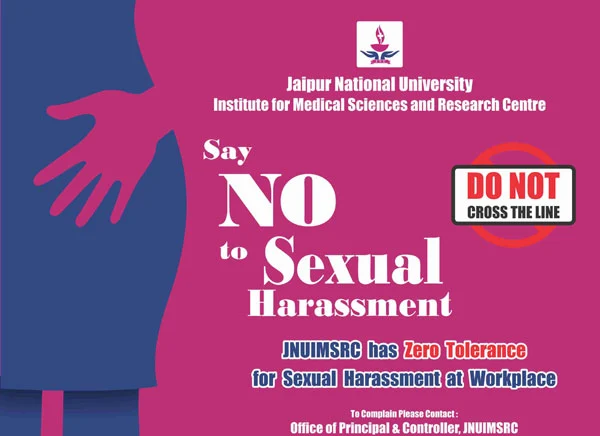
Internal Complaints Committee
Hospital Information
Mandatory information regarding Library holdings
JNUIMSRC declares the following mandatory information as per the requirements of National Medical Commission (NMC)
The JNUIMSRC library system consists of two main components-
- Medical college Library which is located in the basement of the Medical college building.
- Departmental libraries in each of the department to cater to the specific needs of the departments.
The library holdings with regard to books and bound journals etc are provided in the following document-
- Holdings of the college library View Link


