


- About Us
About the University
Jaipur National University, Jaipur is one of the top self-financed private university in Rajasthan sponsored by the Mahima Shiksha Samiti.

Innovation and Incubation
If you have an innovative idea, we can show you the way ahead. Be an entrepreneur with the perfect..
Social Impact/CSR
Social responsibility takes many forms - from providing affordable/free healthcare...
Why JNU?
Their focus is to develop both education and critical skills to help our students excel in life.
- Admissions
- Academics
Schools
- School of Engineering & Technology
- School of Business & Management
- School of Computer & Systems Sciences
- School of Education
- School of Languages, Literature and Society
- School of Life & Basic Sciences
- School of Pharmaceutical Sciences
- School of Media Studies
- School of Fashion Design
- Seedling School of Law and Governance
- Seedling School of Nursing
- Seedling School of Allied and Healthcare Sciences
- School of Agricultural Sciences
- School of Hotel Management & Catering Technology
- Jaipur National University Institute for Medical Sciences and Research Centre
- Research
- Campus Life
Enriching the Intellect

Inspire Your Essence

Outside the classroom

Adapt to Physical Wellness

-

 Admission HelpDesk



-
Duration
2 Years
-
Eligibility
Graduation in any stream
of life science with min 50%.
-
Selection Procedure
Merit+PI
Program Outcomes
Knowledge of Plant Life Forms
Knowledge of fundamentals and advances in studying plant diversity in terms of structure, function and environmental relationships- ranging from Algae to Angiosperms.
Plant Advance Biology
Developing deeper understanding of key concepts of plant biology at biochemical, molecular and cellular level, physiology and reproduction and ecological impact on plants.
The Botanist and society
Apply reasoning informed by the contextual and updated knowledge to assess plant diversity and its importance.
Environment and sustainability
Understand the impact of the plant diversity in societal and environmental contexts, and demonstrate the knowledge of, and need for sustainable development.
Specialized expertise and Project Management
The learners specializes in one of the applied research areas through one of the chosen elective / specialization paper and work with the Master Thesis, which gives special expertise to the students in one of various project areas represented at School of Life Science.
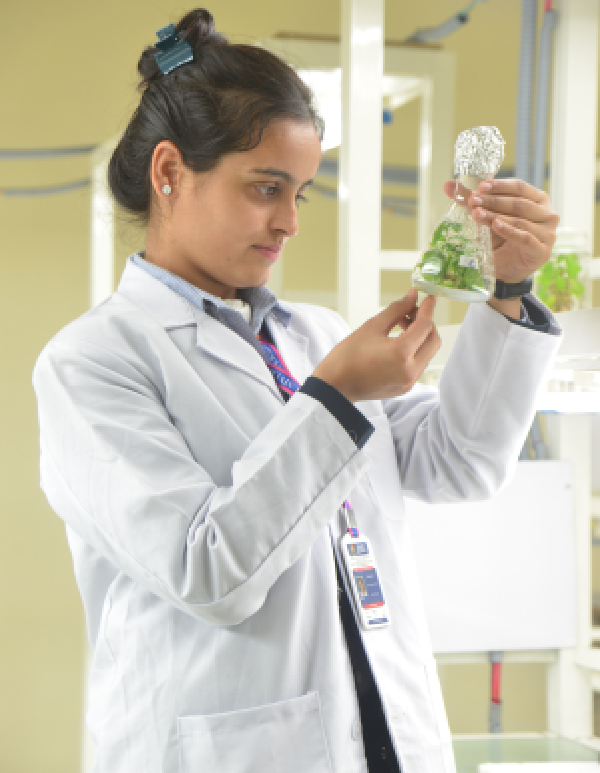
Career Paths

Research Scientist

Plant Biotechnologist

Agricultural Scientist

Environmental Consultant

Teaching and Academia
Curriculum
| Course Category | Course Title | Credits |
|---|---|---|
| Core | Cell Biology | 3 |
| Core | Analytical Techniques | 3 |
| Core | Morphology and Diversity of Non – Vascular Plants | 3 |
| Core | Biology and Diversity of Viruses and Bacteria | 3 |
| Practical I | Practical Based on Cell Biology and Analytical Techniques | 2 |
| Practical II | Practical Based on Morphology and Diversity of Non – Vascular Plants and | 2 |
| Biology and Diversity of Viruses and Bacteria | ||
| Discipline Specific Elective | Ethnobotany and IPR | 2 |
| Herbal Plants and their applications | ||
| DSE Practical | Ethnobotany and IPR | 1 |
| Herbal Plants and their applications | ||
| Ability Enhancement | Soft skills | 2 |
| #Value Added Courses | #Students have to opt any one of the offered Value Added Courses | |
| **EC | **Extracurricular | |
| Total Credits | 21 | |
| Course Category | Course Title | Credits |
|---|---|---|
| Core | Pteridophytes, Gymnosperms and Paleobotany | 3 |
| Core | Molecular Plant Physiology | 3 |
| Core | Taxonomy of Angiosperms | 3 |
| Core | Plant Tissue Culture and its Applications | 3 |
| Practical I | Practical Based on Pteridophytes, Gymnosperms and Paleobotany and Molecular Plant Physiology | 2 |
| Practical II | Practical Based on Taxonomy of Angiosperms and Plant Tissue Culture and its Applications | 2 |
| Discipline Specific Elective | Developmental Plant Biology | 2 |
| Plant Secondary Metabolites | ||
| DSE Practical | Developmental Plant Biology | 1 |
| Plant Secondary Metabolites | ||
| Skill Enhancement | Mushroom Cultivation | |
| Spirulina cultivation | 2 | |
| Biofertilizers | ||
| Skill Enhancement | Mushroom Cultivation | 2 |
| Spirulina cultivation | ||
| Biofertilizers | ||
| Total Credits | 23 | |
| Course Category | Course Title | Credits |
|---|---|---|
| Core | Morphology and Embryology of Angiosperms | 3 |
| Core | Plant Ecology & Environment | 3 |
| Core | Genetics and Plant Breeding | 3 |
| Core | Molecular Biology & Genetic Engineering | 3 |
| Practical I | Practical Based on Morphology and Embryology of Angiosperms and Plant Ecology & Environment | 2 |
| Practical II | Practical Based on Genetics and Plant Breeding and Molecular Biology & Genetic Engineering | 2 |
| Discipline Specific Elective | Research Methodology | 2 |
| Cytogenetics and Crop Improvements | ||
| DSE Practical | Research Methodology | 1 |
| Cytogenetics and Crop Improvements | ||
| Ability Enhancement | Scientific Communications | 2 |
| Seminar | Advancement in Botany | 1 |
| #Value Added Course | #Students have to opt any one of the following ValueAdded Course | |
| **CC | Cocurricular Activity | |
| Total Credits | 22 | |
| Course Category | Course Title | Credits |
|---|---|---|
| Core | Bioinformatics and Basic concepts of AIML. | 3 |
| Practical I | Bioinformatics and Basic concepts of AIML | 1 |
| Elective | MOOC | 2 |
| Bio-entrepreneurship | ||
| Discipline Specific Elective | Plant Pathology | 4 |
| Plant Biotechnology and Bio-resource Management | ||
| Environmental Biotechnology | ||
| DSE Practical | Plant Pathology | 2 |
| Plant Biotechnology and Bio-resource Management | ||
| Environmental Biotechnology | ||
| Dissertation | Dissertation | 12 |
| Total Credits | 24 | |
Tuition Fee
₹30300
Note
*Lab & Library fee will be charged separately
#Program Proposed from Session 2026-27

Apply for admissions at Jaipur National University
APPLY ONLINE 1800-102-1900
  admissions@jnujaipur.ac.in
 Internship Opportunities










Engage, Connect and Experience
the vibrant Life at JNU
Acres Green
Campus
State-of-the-Art
Labs
Smart
Classrooms
Signature Annual
Events
Student
Clubs

Enriching the
Intellect


Inspire Your
Essence


Frequently Asked Questions
All courses in the school are recognized by UGC.
Graduation in any discipline of Life Sciences /Basic Sciences with 50% aggregate.
Yes, the candidate along with his parent or guardian should be present for counseling and admission.
Photostat copies with original documents are required.
No, there is no entrance exam. for M.Sc. in Life Sciences /Basic Sciences.
Marks of qualifying exam + Personal Interview
Examination Fee, Student ID Card, Uniform Charges & Caution Money (Refundable)
No, but there are some other schemes offered to the candidates for taking early admission. Also, the meritorious students are provided one time scholarship.
1 st March, 2020.
After the admission procedure is done for the candidate, Provisional admission letter and fees certificate will be given from the institute. All the formalities with the Bank have to be taken care by the candidate.
All Details are available on university website and University App.
Placement are offered through campus placement. Some students are offered placement at the place they pursue their 6 months dissertation in the 4 th semester. They are also offered placement through alumni links. Students also prefer higher education. Assistance for the same is also given.
Industry: Pharmaceuticals, Biotechnology, Clinical Research, Chemical Industry, Food
industry Bioinformatics, IT Industry,
Academia: CSIR, DBT, ICMR, ICAR Research Labs
Salary: Rs– Rs.2, 50,000 /-3, 50,000 Yearly approx
Functional Area: Research, Production, Maintenance, Quality, Clinical Research
M.Sc. Biotechnology
Industrial Biotechnology, Food Biotechnology, Plant Biotechnology, Microbial Technology
M.Sc. Microbiology
Industrial Microbiology, Environmental Microbiology, Agricultural Microbiology, Food Microbiology, Medical Microbiology
M.Sc. Botany
Environmental Biotechnology, Plant Biotech and Bioresource Management, Plant Pathology
Value added courses like computer languages C++, Phyton Environmental sustainability and development, Workshop and regular special lectures on recent trends in life sciences from experts, cultural and spots activities are part of learning.
55% in qualifying exam + Entrance Test + Personal Interview
Biotechnology, Microbiology & Botany
Only for selected candidates
No, candidate has to appear for CET.
The program covers plant physiology, genetics, taxonomy, ecology, microbiology, molecular biology, and biotechnology, along with practical laboratory work and research projects.
Graduates can pursue careers in research, teaching, environmental consulting, plant biotechnology, agricultural industries, forestry services, and further studies (e.g., Ph.D.).
Yes, the university offers scholarships based on merit, need, and other criteria. You may inquire with the admission office for more specific information.
Yes, fieldwork and internships are often part of the curriculum to provide practical exposure and real-world experience in botanical studies.
The SADTM campus is located on the Jaipur-Agra Bypass Road, about 20Km from Heart of the city. You can reach by private vehicle, or by hiring a taxi or using local conveyanceavailable from major city points.
The SADTM campus is located on the Jaipur-Agra Bypass Road, about 20Km from Heart of the city. You can reach by private vehicle, or by hiring a taxi or using local conveyanceavailable from major city points.


Copyright © 2026 Jaipur National University. All Rights Reserved.
Website Design and Development by Sterco Digitex


Browse by School
- School of Engineering & Technology
- School of Business & Management
- School of Computer & Systems Sciences
- School of Education
- School of Languages, Literature and Society
- School of Life & Basic Sciences
- School of Pharmaceutical Sciences
- School of Media Studies
- School of Fashion Design
- Seedling School of Law and Governance
- Seedling School of Nursing
- Seedling School of Allied and Healthcare Sciences
- School of Agricultural Sciences
- School of Hotel Management & Catering Technology
- Jaipur National University Institute for Medical Sciences and Research Centre