
SMART FARMING AND AGRI-TECH: USING IOT TO BOOST YIELDS
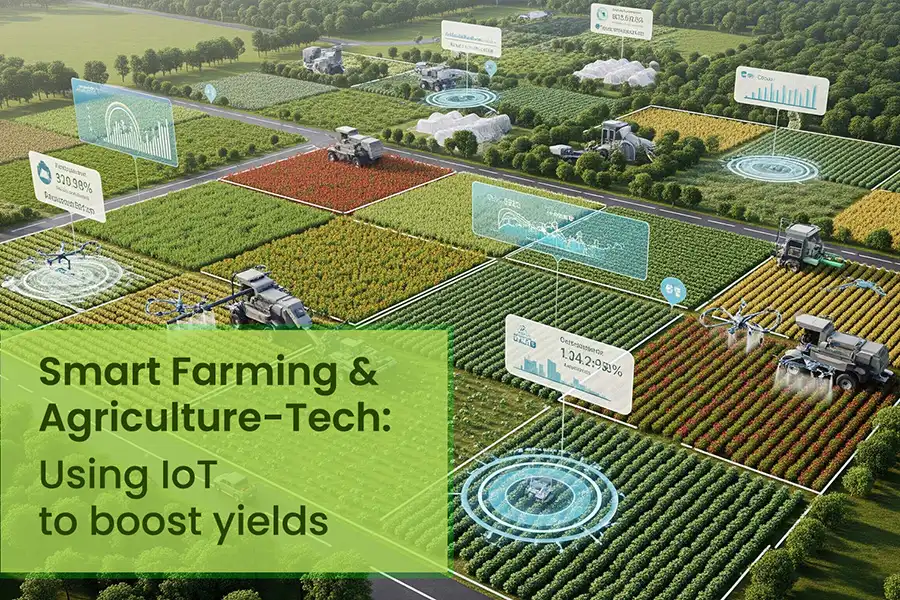
Smart farming, also known as "Smart Agriculture" or “Precision Agriculture” is a concept that uses advanced technologies to monitor and manage the agricultural processes. This approach is based on the use of smart farming technologies, such as smart sensors, cloud services, artificial intelligence (AI), Machine Learning (ML) and the Internet of Things (IoT), Data analytics, Software (IoT platforms) to track, monitor, automate and analyze data to increase the crop production efficiency. These technologies also enable farmers to monitor and control various aspects of their farm operations in real-time, thereby environmental impact. The main goal of smart farming is to optimize the quality and quantity of agricultural productivity while ensuring that the farming workforce is more efficient. Smart agriculture technology based on IoT technologies has many advantages in all agricultural processes and practices in real-time, including irrigation, plant protection, improving product quality, fertilization, disease prediction.
Internet of Things (IoT) a new age modern technological innovations has made the entire farming operation smart and cost effective. Farmers can take informed actions to relatively enhance approximately every area of their work, from crop to livestock farming (Neogy & Paruchuri, 2014).
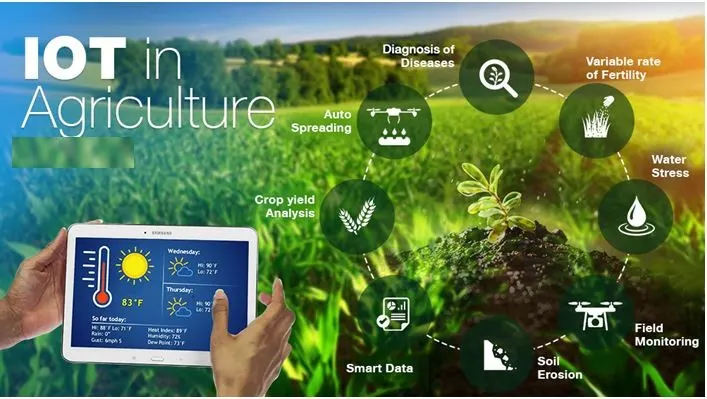
(Source: enterprisersproject.com)
Technologies based in IoT Farming
- Global Positioning System (GPS)- Global Positioning System satellites helps in transmitting signals and permit GPS receivers to compute their location in real-time, and provide continuous positions while moving. Further, the system facilitates the recognition of various field locations in order to then apply the necessary inputs (seed, fertilizer, herbicide, pesticide, and water) to a particular field.
- Geographic Information System (GIS)- The GIS database provides information on field soil types, nutrient status, topography, irrigation, surface and subsurface drainage, quantity of chemical applications, and crop production, and also establishes the relationship between elements that affect a crop on a particular farming field.
- Crop Management- Crop monitoring methods are usually based on the interpretation of remote-sensing-derived indicators by comparing actual crop status to previous crop data. Among the different indices, the normalized difference vegetation index (NDVI) is the most popular indicator to assess vegetation health and crop production, due to the closely related leaf area index (LAI) and photosynthetic activity of green vegetation seasons.
- Soil and Plant Sensors- Soil sensors and plant monitors the real-time physical and chemical signals in soil, such as moisture, pH, temperature, and pollutants, and provide information to optimize crop growth conditions, fight against biotic and abiotic stresses, and increase crop yields.
Applications in Agriculture
- Climate Monitors- Weather stations presumably the most applicable and used IoT-connected agriculture devices. It works by combining several IoT farming sensors. The analysis provided can be used in mapping the conditions of climate, select reasonable crops and implement the needed strategies to enhance crop capacity. This is also referred to as precision farming (Ganapathy, 2016)
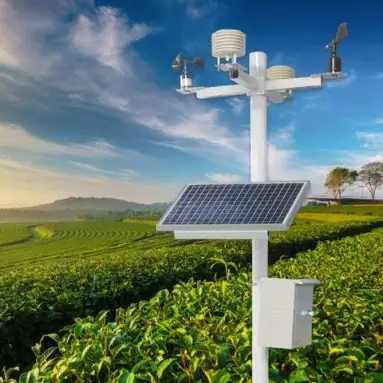
(Source: google images)
- Automated Greenhouse- The traditional means of intervention in greenhouse environment management by farmers is manual and time taking. With the help of IoT sensors, accurate real-time data on the conditions of the greenhouse such as temperature, humidity, soil conditions and lighting can be obtained.
- Cattle Management and Monitoring- Several IoT agriculture sensors may be attached to farm livestock to keep track of their health status and record performance.
- Precision Agriculture- Also known as precision farming, and most popularly used and efficient IoT based application in modern agricultural system. It works by gathering accurate and efficient data-based actions. Farmers can use this data to enhance the measure and quantity of pesticides, fertilizers, and water that their products need to lower cost and increase the level of health of crops.
- Farm Drones- Drones are also known as unmanned ariel vehicles (UAVs). They are better suited for farm data collection and gathering than satellites or aeroplanes. Drones can carry out several tasks (i.e. apart from its surveillance features) that human workers will normally do. Tasks such as pests fighting, planting and monitoring crops, farm spraying and so on.
CONCLUSION
The Internet of Things is part of the technological advancements that are changing the mode of human operations worldwide. Farmers can use sensors and other IoT devices to gather data and carry out analyses for accurate estimates. With IoT capabilities, farmers can be able to optimize functions and improve yield at a lower rate. These may also result in reduced costs for consumers. This article emphasized the role of many technologies used for farming, particularly the IoT, in making agriculture smarter and more effective in meeting future requirements.
REFERENCES
- Neogy, T. K., & Paruchuri, H. (2014). Machine Learning as a New Search Engine Interface: An Overview. Engineering International, 2(2), 103-112. https://doi.org/10.18034/ei.v2i2.539
- Ganapathy, A. (2016a). Blockchain Technology Use on Transactions of Crypto Currency with Machinery & Electronic Goods. American Journal of Trade and Policy, 3(3), 115-120. https://doi.org/10.18034/ajtp.v3i3.552
Author- Yabi Gadi and R.K Bansal
School of Language, Literature, and Society
 Back
BackRecent Post
- How to Find the Best Universities in Uttar Pradesh?
- Why Digital Marketing Is One of the Most Future-Ready MBA Specializations
- How to build the best CAT preparation strategy
- The Role of Nurses in Societal Stratification: Medicine for Life
- BBA Full Form Explained: Is This The Right Degree For You?
- BCA Full Form, Subjects, and Career Pay
- The JEE Exam Has More To It Than Just Tough Questions
- Everything About NID, The National Institute Of Design
- My First Clinical Experience: Reflection on Mistakes, Learning & Developing Competence
- From Textbooks to Heartbeats: What Students Should Not Experience
Categories
Archives
Contact Form


Copyright © 2026 Jaipur National University. All Rights Reserved.
Website Design and Development by Sterco Digitex


Browse by School
- School of Engineering & Technology
- School of Business & Management
- School of Computer & Systems Sciences
- School of Education
- School of Languages, Literature and Society
- School of Life & Basic Sciences
- School of Pharmaceutical Sciences
- School of Media Studies
- School of Fashion Design
- Seedling School of Law and Governance
- Seedling School of Nursing
- Seedling School of Allied and Healthcare Sciences
- School of Agricultural Sciences
- School of Hotel Management & Catering Technology
- Jaipur National University Institute for Medical Sciences and Research Centre