
My First Clinical Experience: Reflection on Mistakes, Learning & Developing Competence
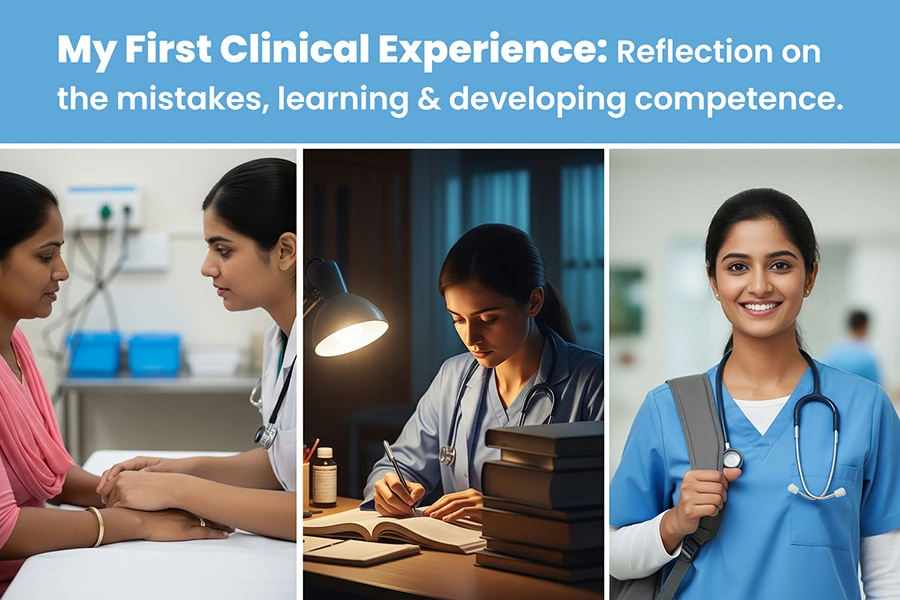
The transition from a student immersed in theory to a professional navigating real clinical scenarios is one of the most significant transformations in a healthcare career. My journey into the field of medical laboratory science began with a blend of excitement, anticipation, and, inevitably, a fair share of mistakes. Reflecting on that early phase, I can say with conviction that my first clinical experience laid the foundation not just for technical competence but also for the emotional maturity needed to thrive in this field.
Entering the Lab: The Reality Check
My first day in a clinical lab remains etched in my memory. Clad in a freshly pressed lab coat, I was eager to put years of academic learning into practice. As a graduate of a vocational Medical Laboratory Technology (MLT) program, I aspired to make a meaningful contribution. However, it didn’t take long for reality to set in.
Within the first week, I mishandled the centrifugation of a urine sample, which led to a misinterpreted sediment analysis. Although the mistake did not result in clinical harm, it was a sobering experience. It underscored the critical importance of attention to detail in a profession where patient outcomes hinge on the accuracy and reliability of laboratory reports.
Mistakes: A Crucible for Growth
Rather than being disheartened, I chose to treat mistakes as learning opportunities. I began to ask critical questions: What went wrong? What could I do better? Who can I learn from? These reflections became a catalyst for my transformation into a more meticulous and accountable professional.
I quickly understood the importance of strictly following Standard Operating Procedures (SOPs), maintaining precise documentation, and ensuring proper sample collection, handling, and labeling. Small but essential habits — like double-checking patient IDs and calibrating analyzers regularly — became ingrained in my routine and remain central to my practice.
Gaining Clinical Depth: From Local Labs to International Standards
My clinical journey eventually took me to King Fahad Specialist Hospital in Dammam, Saudi Arabia. There, I worked under the stringent guidelines of the College of American Pathologists (CAP), gaining exposure to international best practices in quality control and laboratory accreditation.
This experience reinforced my belief that excellence in laboratory science extends beyond technical expertise. It involves traceability, consistency, and a culture of accountability. My time in that setting significantly shaped my understanding of global healthcare standards and strengthened my commitment to continuous improvement.
Teaching Through Experience: Shaping Future Technologists
Currently, as a faculty member in the Department of Medical Laboratory Technology at Jaipur National University, I draw from these formative experiences to shape the next generation of laboratory professionals. I integrate real-life case scenarios and mistakes into the curriculum to promote critical thinking.
I encourage students to go beyond rote learning by posing questions like: Why is a particular sample refrigerated? What happens if analysis is delayed? What are the downstream clinical consequences? These discussions not only enhance understanding but also foster professional judgment and clinical reasoning.
We also facilitate post-internship debriefs, encouraging students to reflect on their clinical exposure, challenges encountered, and personal growth. These sessions often lead to rich discussions on ethics, communication, and teamwork — all of which are essential competencies in the clinical laboratory environment (Kolb, 2014).
From Reflection to Research and Innovation
Interestingly, early clinical mistakes also became the seeds of research curiosity. My interest in early diagnostic biomarkers for acute kidney injury (AKI), for example, emerged from real-life cases where standard tests failed to detect early signs. This curiosity has since led to multiple research publications, national and international conference presentations, and even collaborative work on patents related to diagnostic innovations.
From managing immunoassay analyzers at Dr. Lal PathLabs to contributing to genomic sequencing panel development for transplantation pharmacogenomics, my professional path has been one of constant reflection, academic exploration, and translational research.
Building Competence: Beyond the Classroom
True competence in medical laboratory science transcends textbook knowledge. It encompasses:
- A strong ethical foundation
- Commitment to quality assurance
- Interdisciplinary collaboration
- Adaptability to evolving technology
At Jaipur National University, we are committed to integrating these dimensions into our curriculum through simulation labs, hospital tie-ups, case-based discussions, and national conference exposure. Our goal is to ensure that students graduate with not only theoretical knowledge but also real-world readiness.
The Journey Continues: Lessons for Educators and Students
For educators, it is imperative that clinical experience remains central to pedagogy. Virtual labs and theoretical instruction have value, but they can never fully replace the hands-on, high-stakes learning that real clinical environments provide.
For students, my message is simple: embrace your mistakes. Every misstep, every correction, and every moment of self-doubt is part of the process. These experiences shape you into a professional worthy of the trust that patients and physicians place in our reports (Schon, 1983).
Final Thoughts: Work is Worship
My first clinical experience taught me humility, patience, and perseverance — values that no classroom could ever fully impart. It reminded me that while competence is built over time, character is revealed in how we respond to failure.
Today, I am proud to serve as a professor at Jaipur National University — an institution that not only promotes academic rigor but also instills professional integrity and human empathy in future healthcare professionals.
References :
College of American Pathologists. (n.d.). CAP accreditation checklists.https://www.cap.org
- Kolb, D. A. (2014). Experiential learning: Experience as the source of learning and development (2nd ed.). Pearson Education.
- Schön, D. A. (1983). The reflective practitioner: How professionals think in action. Basic Books.
- World Health Organization. (2020). Laboratory quality management system: Handbook.
Dr. M. V Simha
Professor
School of Allied Health Sciences
 Back
BackRecent Post
- How to Find the Best Universities in Uttar Pradesh?
- Why Digital Marketing Is One of the Most Future-Ready MBA Specializations
- How to build the best CAT preparation strategy
- The Role of Nurses in Societal Stratification: Medicine for Life
- BBA Full Form Explained: Is This The Right Degree For You?
- BCA Full Form, Subjects, and Career Pay
- The JEE Exam Has More To It Than Just Tough Questions
- Everything About NID, The National Institute Of Design
- My First Clinical Experience: Reflection on Mistakes, Learning & Developing Competence
- From Textbooks to Heartbeats: What Students Should Not Experience
Categories
Archives
Contact Form


Copyright © 2026 Jaipur National University. All Rights Reserved.
Website Design and Development by Sterco Digitex


Browse by School
- School of Engineering & Technology
- School of Business & Management
- School of Computer & Systems Sciences
- School of Education
- School of Languages, Literature and Society
- School of Life & Basic Sciences
- School of Pharmaceutical Sciences
- School of Media Studies
- School of Fashion Design
- Seedling School of Law and Governance
- Seedling School of Nursing
- Seedling School of Allied and Healthcare Sciences
- School of Agricultural Sciences
- School of Hotel Management & Catering Technology
- Jaipur National University Institute for Medical Sciences and Research Centre