
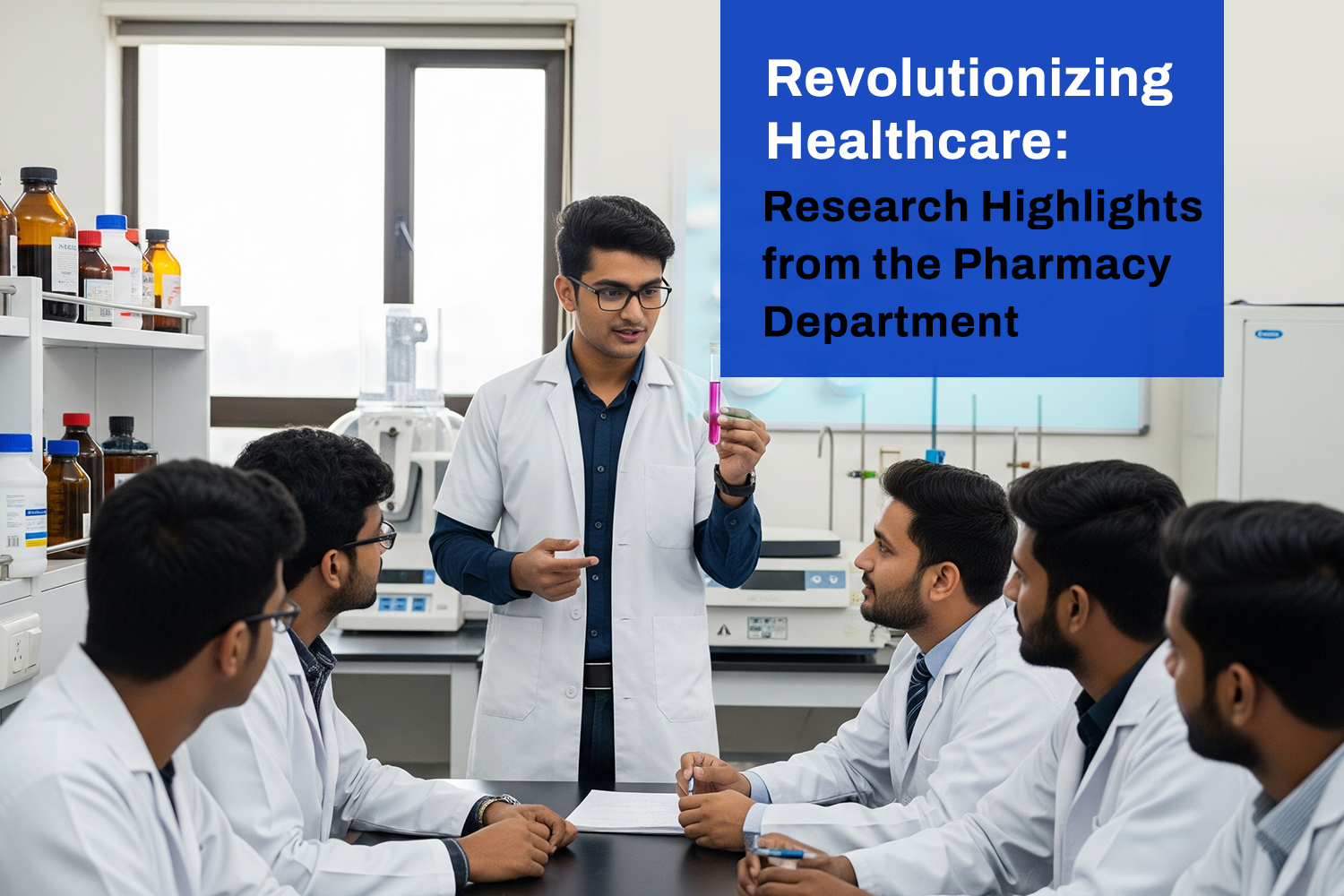
Revolutionizing Health Care: Research Highlights from the Pharmacy Department

Dr. Manisha Nidhar,
Assistance Professor,
SOPS,
Jaipur National University,
Jaipur
Revolutionizing healthcare means to the major innovations happening in the healthcare industry because of advancements in technology and creative strategies, leading to enhanced patient outcomes and improved healthcare delivery.
These developments are mobile devices, telemedicine, artificially intelligent (AI), and 3D printing, have transformed a number of healthcare domains, from patient monitoring and operational efficiency to diagnosis and treatment.
In this blog we included significant research highlights from the pharmacy institutes and additionally demonstrated how effectively research in pharmacy is transforming in the health care systems. Now health care is not only treating diseases but also includes how to prevent, diagnose and individualized treatments.
Originally focused on the manufacture and dispensing of drugs, pharmacy is increasingly branching out into digital health, pharmacogenomics, biotechnology, and clinical therapies.
Research Highlights from the Pharmacy Department; here’s a detailed of how to revolutionized healthcare firstly discusses about artificial intelligence (enhanced diagnostics, individualized treatment plans, drug discovery, improved efficiency and AI in clinical trials), secondly, telemedicine and remote patient monitoring (increased accessibility and real-time monitoring), 3D printing (customized prosthetics and implants), other innovations ( electronic health records, internet of medical things, digital vaccines).
1. Artificial Intelligence: AI is increasingly transforming healthcare across various domains being used to automate, optimize and personalize various aspects of the pharmacy industry, from diagnostics and drug discovery to drug dispensing to individual treatment and also administrative work. This blog, explores the potential of artificial intelligence to revolutionize the pharmacy department, by describing the applications and useful AI tools of artificial intelligence. These tools increased diagnostic precision, treatment personalization, and improving patient outcomes by streamlining workflows and predicting potential health risks. AI tools can accurately analyse medical images such as X-rays, MRIs and early detection allows management of disease risk factors, medical intervention and lifestyle adjustments for illness like cancer and CVS conditions. On the basis of medical history, genetic information, and lifestyle factors of individual patient, AI tools help to create tailored treatment plans. AI also very useful for the drug discovery and development by analyze data and identifying lead drug molecules and also effects of drug on patients.
2. Telemedicine and Remote Patient Monitoring: It increased accessibility and real time monitoring of patients, such as telemedicine improves access to care, particularly in poor regions, by permitting patients to consult with medical professionals remotely, thereby avoiding geographic limitations. Nowadays wearable devises are useful to continuous tracking of sign, symptoms and health indicators, for early management of patient conditions.
3. 3D Printing: 3D printing is revolutionizing the pharmacy sector through the development of customized medication, novel drug delivery systems and drug development. It enables the development of individualized drugs dosages, forms, and release patterns that are suited to the requirements of each patient, providing patient-centered therapies. These technologies significantly will improve patient care and transform the development, manufacturing, and distribution of pharmaceuticals. It includes customized prosthetics and implants, electronic health records, internet of medical things and digital vaccines,
4. Other Innovations: It includes electronic health records, internet of medical things and digital vaccines, in addition to enhancing patient care, these developments and technologies are increasing the effectiveness and economy of our healthcare. In order to deliver high-quality treatment, healthcare providers must remain up to date on new technologies and embrace them.
Conclusion
The pharmacy department is a key player in the advancement of healthcare. Nowadays pharmaceutical is doing more than just dispensing medicines because of emerging technology like telemedicine, 3D printing, artificial intelligence (AI), and digital tools. These days, advance technologies helping in the development of effective and individualized methods for the prevention, diagnosis, and treatment of illnesses. Telemedicine is useful for people, who are living in rural places, where they can communicate with doctors without having to travel at hospital. These days, wearable technology like smartwatches, fitness trackers, wearable ECG monitors, glucose monitors, biosensors and posture correctors enables people constantly monitor our well-being and early disease detection can help management of disease, whereas 3D printing assists in the development of individualized medications, implants and advance drug delivery. The treatment of patients is also being improved by other vital technologies including digital health records, smart medical devices, and digital immunizations. As a result of these developments, healthcare is becoming more individualized, quicker, and easier to access.
References
- Alowais, S.A., Alghamdi, S.S., Alsuhebany, N. et al. Revolutionizing healthcare: the role of artificial intelligence in clinical practice. BMC Med Educ 23, 689 (2023). https://doi.org/10.1186/s12909-023-04698-z.
- Kandhare P, Kurlekar M, Deshpande T, Pawar A. A Review on Revolutionizing Healthcare Technologies with AI and ML Applications in Pharmaceutical Sciences. Drugs and Drug Candidates. 2025; 4(1):9. https://doi.org/10.3390/ddc 4010009.
- Manvi Chauhan, Emerging Trends in Telemedicine and Remote Patient Monitoring: Improving Access to Healthcare Services, Mini Review-International Research Journal of Basic and Clinical Studies, (2023) Volume 8, Issue 3.
- Frenzel JE. Using simulation to improve the education of health care professionals. Am J Pharm Educ. 2010;74(9):190.
- Kvedar J, Fogel AL, Elenko E, Zohar D. Digital medicine's march on chronic disease. Nat Biotechnol. 2016;34(3):239–246.
 Back
BackRecent Post
- How to Find the Best Universities in Uttar Pradesh?
- Why Digital Marketing Is One of the Most Future-Ready MBA Specializations
- How to build the best CAT preparation strategy
- The Role of Nurses in Societal Stratification: Medicine for Life
- BBA Full Form Explained: Is This The Right Degree For You?
- BCA Full Form, Subjects, and Career Pay
- The JEE Exam Has More To It Than Just Tough Questions
- Everything About NID, The National Institute Of Design
- My First Clinical Experience: Reflection on Mistakes, Learning & Developing Competence
- From Textbooks to Heartbeats: What Students Should Not Experience
Categories
Archives
Contact Form


Copyright © 2026 Jaipur National University. All Rights Reserved.
Website Design and Development by Sterco Digitex


Browse by School
- School of Engineering & Technology
- School of Business & Management
- School of Computer & Systems Sciences
- School of Education
- School of Languages, Literature and Society
- School of Life & Basic Sciences
- School of Pharmaceutical Sciences
- School of Media Studies
- School of Fashion Design
- Seedling School of Law and Governance
- Seedling School of Nursing
- Seedling School of Allied and Healthcare Sciences
- School of Agricultural Sciences
- School of Hotel Management & Catering Technology
- Jaipur National University Institute for Medical Sciences and Research Centre