
Everyday Inclusion: Advancing Gender Diversity in Indian Education
Prof. Rita Arora,
School of Education,
Jaipur National University,
Jaipur
India stands at a critical moment in its quest for gender equality in education. Much has been accomplished-like rising enrollment in higher education for women, and that women now make up more than 53% of school teachers-but real inclusion does not depend on policies alone, but on the mundane daily behavior of individuals and institutions.
India was placed 129th among 146 countries in the 2024 Global Gender Gap report, citing persistent gaps in educational levels. Literacy rates remain unequal, and cultural and socioeconomic obstacles impede access to education, especially at secondary and higher levels.
There is a ray of hope the women's gross enrollment ratio (GER) in higher education has increased to 28.5%, and we hear feminization of teaching profession not only the fact that women are doing well in Science, Technology, Engineering and Mathematics. These trends show the strength of overlong reforms and the role of inclusive practices in day to day learning in formal and Informal education.
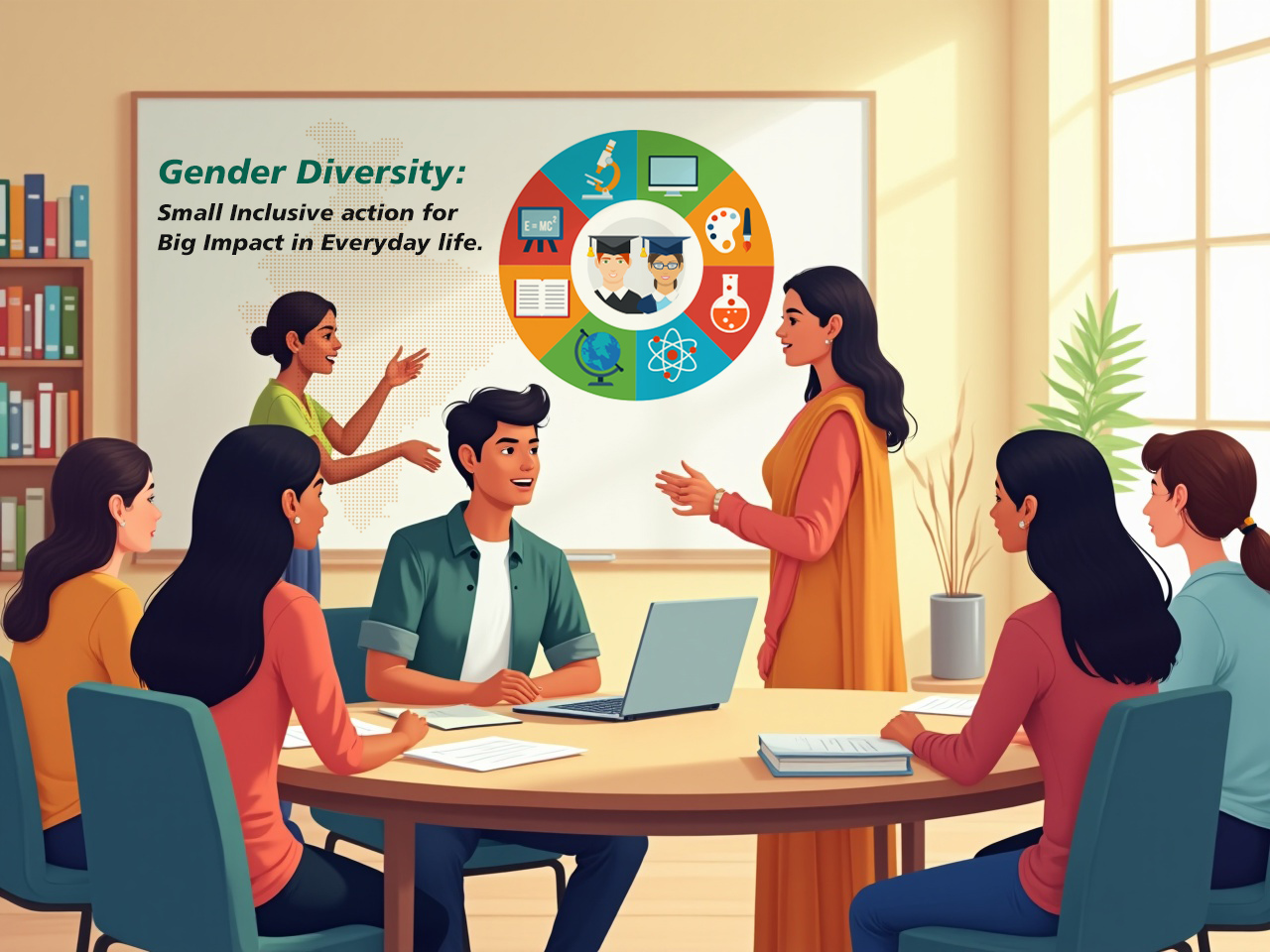
Inclusive language in the classroom has become a habit-using terms like “learners” instead of gendered words-“naps” at inclusion and encourages a respectful and conducive and comforting environment. Learners are occasionally represented as she/he. This small change ensures that everyone is understood and valued, creating a classroom life where diversity is valued and equality of participation is promoted.
Teachers can work together to create a learning environment by giving all learners equal opportunities for interaction, leadership, and extracurricular activities. Promoting balanced participation helps children gain confidence and allows both boys and girls to make important contributions. Simple strategies, like rotating leadership positions, promote fairness and create a more equitable classroom environment.
Emphasizing successful women in education materials and inviting female experts as guest speakers placing them in various selection committees, board of management can inspire students and open their horizons. Female teachers have an important role to play in guiding young girls, especially in areas such as STEM where gender disparities continue to exist. This goes a long way towards instilling confidence and ambition and filling existing gaps.
Shattering gender stereotypes in school involves creating spaces where students are able to engage with the things they love without external constraints. Encouraging boys into arts and care-giving and encouraging girls into sport and science instills a more open-minded approach. Such practices enable students to examine wide-ranging opportunities that lie outside of conventionalism.
Inclusive infrastructure development is needed in ensuring equitable educational opportunities. Clean and safe facilities, availability of sanitary products, and gender-sensitive space provision enhance student enrollment and participation, especially among marginalized communities. These interventions create a conducive environment in which all learners can excel without basic needs-related barriers.
Strengthening alliances among teachers, families, and communities is a primary avenue for promoting gender-sensitive education. Encouraging parents to discuss the need for girls' education and the eradication of societal stereotypes helps create inclusive learning environments. Community-based programs also strengthen educational equity with lasting commitment to educating girls and filling gaps.
Through ongoing examination of trends, institutions and universities are creating better policies that foster inclusive learning spaces, making inclusion not merely an objective but an assessable and practical commitment.
Attaining gender equality in Indian education is a task that takes concerted effort. Every small step-be it within classrooms, faculty gatherings, or outreach into the community-can lead to a larger change. The educators themselves bear tremendous responsibility in either maintaining or dismantling established obstacles. By deliberately incorporating inclusive behaviors into daily interactions, schools and universities can promote increased equality, ultimately creating a more empowered and equitable society. Real progress doesn't always emanate from grand overhauls-it originates from the steady dedication to inclusion in everyday life.
References:
1. Down to Earth (2024). "Gender Gap Report 2024: India Ranks Poorly in Political Parity Indices Compared to Bangladesh, Nepal, Sri Lanka, and Bhutan." Environment and Development Magazine.
2. Manjrekar, Nandini (Ed.). (2023). Gender and Education in India: A Reader. London: Routledge.
3. Ministry of Education, Government of India (2022). All India Survey on Higher Education (AISHE) 2021-2022. New Delhi: Department of Higher Education.
4. Ministry of Statistics and Programme Implementation, Government of India (2022). Women and Men in India 2022. New Delhi: Government of India.
5. Ramachandran, Vimala (Ed.). (2004). Gender and Social Equity in Primary Education: Hierarchies of Access. New Delhi: Sage Publications.
6. World Economic Forum (2024). Global Gender Gap Report 2024. Geneva: World Economic Forum. Available at: https://www.weforum.org/publications/global-gender-gap-report-2024/
 Back
BackRecent Post
- How to Find the Best Universities in Uttar Pradesh?
- Why Digital Marketing Is One of the Most Future-Ready MBA Specializations
- How to build the best CAT preparation strategy
- The Role of Nurses in Societal Stratification: Medicine for Life
- BBA Full Form Explained: Is This The Right Degree For You?
- BCA Full Form, Subjects, and Career Pay
- The JEE Exam Has More To It Than Just Tough Questions
- Everything About NID, The National Institute Of Design
- My First Clinical Experience: Reflection on Mistakes, Learning & Developing Competence
- From Textbooks to Heartbeats: What Students Should Not Experience
Categories
Archives
Contact Form


Copyright © 2026 Jaipur National University. All Rights Reserved.
Website Design and Development by Sterco Digitex


Browse by School
- School of Engineering & Technology
- School of Business & Management
- School of Computer & Systems Sciences
- School of Education
- School of Languages, Literature and Society
- School of Life & Basic Sciences
- School of Pharmaceutical Sciences
- School of Media Studies
- School of Fashion Design
- Seedling School of Law and Governance
- Seedling School of Nursing
- Seedling School of Allied and Healthcare Sciences
- School of Agricultural Sciences
- School of Hotel Management & Catering Technology
- Jaipur National University Institute for Medical Sciences and Research Centre