
Bridging Theory and Practice: How Business Management Programs Prepare Students for Industry Readiness
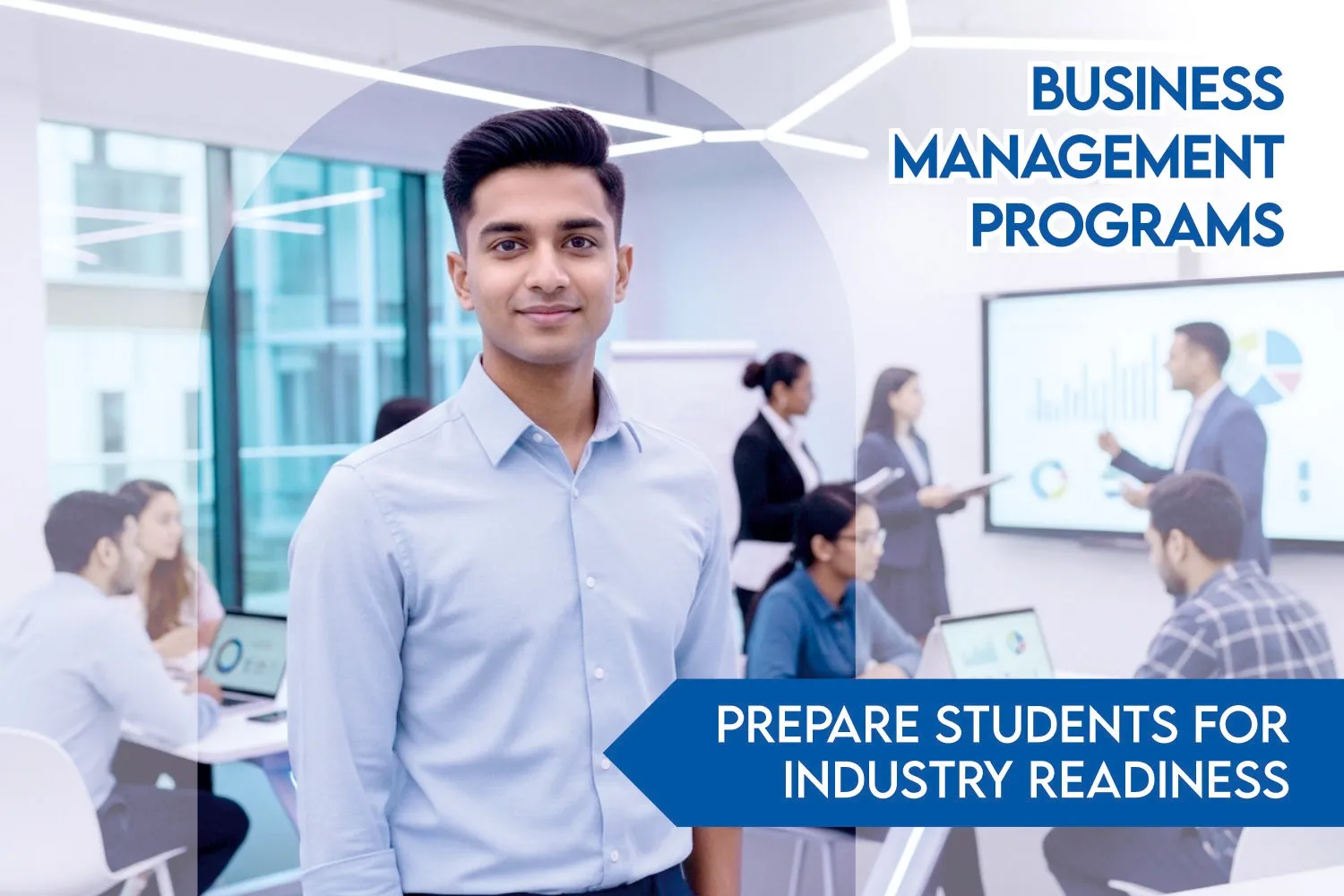
Introduction:
With the world of modern business changing at such a rapid pace, there is an underlying question that is reverberating down corporate corridors and classroom corridors alike: Does business school really prepare graduates to the realities of the workplace? The perceived discrepancy between the theory and application of the academic field of study has been subject to disagreement among the employers, educators and the students. However, the current progressive business management courses are methodically tearing this gap with new methods that not only guarantee the graduates acquire knowledge in business, but they can also directly apply the knowledge to address real life challenges.
This change is sensitive to the new market message: though a 2024 LinkedIn Workforce Learning Report identifies 87 percent of employers as seeking practical skills and experience, rather than educational qualifications, in hiring. This change in employer demands has spawned a pedagogical revolution in business education, as increasingly progressive institutions have radically redefined the way they prepare students to be industry ready.
The Evolving Pedagogy: From Passive Learning to Active Application
Historical business education tended to focus on abstract theories, the case studies of decades ago, and the idyllic situations inside the corporations. Where the basic knowledge is essential, the modern curriculum has changed to focus on practical implementation in a number of methodologies:
- Experience Learning Platforms.
Learning by doing is accepted as one of the principles in leading business schools. Students do not simply read about supply chain management anymore, they rationalize actual distribution networks of partner companies. They do not just learn the theory of marketing, they create and test marketing campaigns of real products. An example of this is the cooperative education model proposed in Northeastern University which entails incorporating six month professional placements within undergraduate courses so that upon graduation, students are equipped with at least 18 months of workplace exposure. - Industry-Integrated Projects
Most programs are now incorporating live consultancy projects in their curriculum. In the Wharton Field Application Project, student teams collaborate directly with executives to address key business issues, including entry mode strategies to business operation optimization. These projects offer real-life deliverables to businesses as well as offer students portfolio-level experience and work references prior to graduation. - Simulation and Technology Integration.
Complex decision-making has been transformed in advanced business simulations to provide a powerful experience to the students. Capsim and Marketplace are platforms that enable teams to operate virtual companies in several quarters and feel the impact of their strategic actions in risk-free environments. On the same note, the incorporation of actual industry tools, such as Tableau to visualize data, Salesforce to utilize CRM, SAP to use to enterprise resource planning makes technical expertise and conceptual knowledge guaranteed.
The Core Competency Framework: What Industry-Ready Really Means
The modern business programs are aimed at creating a balanced set of competences that are always in demand by the employers:
- Technical and Analytical Competency.
The modern graduates have become proficient in data analytics, financial modelling software and online marketing platforms. An example of this is the University of Texas at Austin, which in the McCombs School, Python and R programming are being taught in business core courses, as they have come to understand that data literacy is no longer an esoteric domain but a core business competency. - Strategic Thinking and Problem-Solving.
Case competitions, business plan development, and strategic simulations allow students to exercise a transition between identification of the problem and implementation of solutions. An example of such practice would be the MIT $100K Entrepreneurship Competition, where students are asked to create a business idea and bring it to life, concept through pitch, and many of them have successfully established businesses. - Collaborative Intelligence and communication.
Communication skills and cross-disciplinary work help develop the ability to convey difficult concepts and work in various teams. The programs are now taking the shape of workplace dynamics in that they create teams with diverse academic backgrounds and with the same team they need a deliverable requiring multiple perspectives to be integrated. - Adaptive Leadership and Emotional Intelligence.
Curriculum in contemporary society acknowledges that technical skills do not suffice. Change management, team dynamics, and organizational behavior courses are not only taught theoretically, but they are taught through experiential learning methods such as 360-degree feedback, peer coaching, and reflective leadership journals.
The Industry-Academia Partnership Model.
Preparation is best done when there is a porousness of the boundary between classroom and boardroom. A number of mechanisms of this integration have been put in place by progressive institutions:
- Executive-in-Residence Programs
Experienced practitioners also incorporate into academic programs, injecting current industry issues into the classroom and also offering mentorship which is based on industry experience. Presence of them makes curriculum relevant to changing business environments. - Corporate Advisory Boards
Businesses are engaged in curriculum development, which means that the programs are responsive to the developmental skill gaps. The partnership of Adobe with multiple business schools in digital marketing programs, including, but not limited to the example of business schools, aids in assuring graduates that they have skills that they can apply to their work as soon as they graduate in a highly dynamic area. - Real-Time Case Development
Students are starting to analyze contemporary business situations rather than just historical ones, and occasionally they have access to the actual executives of the organization who take the decisions to be made. The quick-thinking skills are developed in the Harvard Business School because of its culture of cold calls, where students have to analyze and defend their positions concerning current business scenarios and do not have any training to do so.
Measuring Impact: Grades to Beyond to Performance Metrics.
- Skills-Based Portfolios of Assessment.
More and more graduates are handing in digital portfolios showing not only what they have learned but also what they achieved - marketing campaigns with definite outcomes, process refinements with definite efficiencies, strategic analyses that were put into practice by partner organizations. - Employer Feedback Loops
Proactive programs have well-organized feedback systems with their recruitment agencies, to monitor the progress of the graduates in the first-year positions and use this information to continuously improve the curriculum and the pedagogical strategies. - Career Trajectory Analytics.
Top universities and colleges are no longer considering only the rates of placement, but also career velocity, the speed at which graduates are placed in jobs with greater responsibility and influence. This longitudinal follow-up gives strong evidence of the effectiveness of the program.
Resolving the Enduring Issues.
- Faculty Development
Traditional academic incentives focus on research as compared to innovation in teaching and industry involvement. This is being dealt with by progressive institutions by teaching-track posts, industry-sabbaticals, and curriculum-innovation. - Curriculum Agility
Business evolution can be so fast that the curriculum approval processes may become traditional. Newer programs are adopting modular micro-curricula that can be swiftly revised to meet new trends such as integration of AI, sustainability reporting of blockchain application. - Access and Equity
Experiential elements that are high impact may impose financial and logistical obstacles. Possible solutions are virtual internships, remote consulting projects, and scholarship funds that are devoted to the opportunity of experiential learning.
The Future of Industry-Ready Business Education.
- Individual Learning Profiles.
- Micro-Credentialing Integration
- Learning Ecosystems throughout life.
Conclusion: The New Standard of Excellence
The most significant business management programs have ceased to pose the question of whether they must connect theory and practice and have started to reflect how efficiently they do it...
Prof ( Dr) Sumedha Bajpai
Head
 Back
BackRecent Post
- How to Find the Best Universities in Uttar Pradesh?
- Why Digital Marketing Is One of the Most Future-Ready MBA Specializations
- How to build the best CAT preparation strategy
- The Role of Nurses in Societal Stratification: Medicine for Life
- BBA Full Form Explained: Is This The Right Degree For You?
- BCA Full Form, Subjects, and Career Pay
- The JEE Exam Has More To It Than Just Tough Questions
- Everything About NID, The National Institute Of Design
- My First Clinical Experience: Reflection on Mistakes, Learning & Developing Competence
- From Textbooks to Heartbeats: What Students Should Not Experience
Categories
Archives
Contact Form


Copyright © 2026 Jaipur National University. All Rights Reserved.
Website Design and Development by Sterco Digitex


Browse by School
- School of Engineering & Technology
- School of Business & Management
- School of Computer & Systems Sciences
- School of Education
- School of Languages, Literature and Society
- School of Life & Basic Sciences
- School of Pharmaceutical Sciences
- School of Media Studies
- School of Fashion Design
- Seedling School of Law and Governance
- Seedling School of Nursing
- Seedling School of Allied and Healthcare Sciences
- School of Agricultural Sciences
- School of Hotel Management & Catering Technology
- Jaipur National University Institute for Medical Sciences and Research Centre